
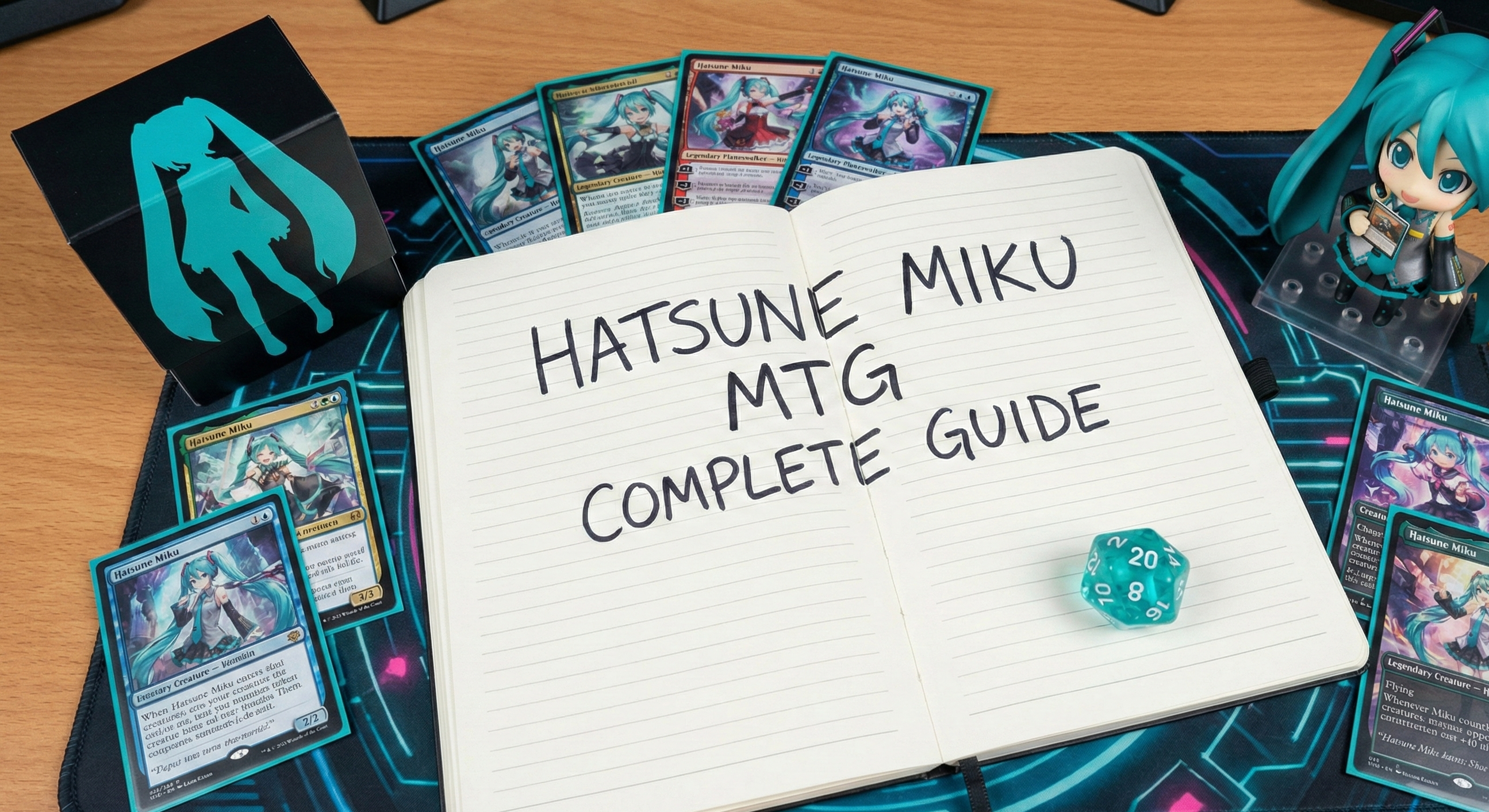

Quick Verdict
The Secret Lair x Hatsune Miku collaboration spanned a full year with four seasonal drops, generating secondary market premiums exceeding 5,000% for chase cards. This definitive guide covers every drop, the Encore Electromancer lottery, and the shift toward aesthetic tribalism in deck building.
TOP RECOMMENDATIONS
.jpg)
Encore Electromancer (Snapcaster Mage)
Ultimate Lottery Card - The rarest chase card with 1-5% drop rate
- ✓Ultra-scarce lottery card across all four drops
- ✓Non-foil: $999, Foil: $1,800+
.jpg)
Sol Ring (Digital Sensation)
Best Status Symbol - 23x multiplier on the most played Commander card
- ✓23x multiplier over standard Sol Ring ($1.50 → $35.59)
- ✓Every Commander deck needs one
.jpg)
Swan Song (Winter Diva Foil)
Best Competitive Staple - First foil printing since Theros 2013
- ✓cEDH staple with first foil printing in years
- ✓Foil version valued at $62.51+
SAFETY TECHNOLOGY Expert Analysis.
The intersection of Magic: The Gathering, the world's premier trading card game, and Hatsune Miku, the global virtual pop icon, represents a watershed moment in the evolution of Wizards of the Coast's Universes Beyond product strategy. Spanning a full calendar year from the Spring Superdrop of 2024 to the Winter Superdrop of 2025, the Secret Lair x Hatsune Miku collaboration was not merely a cosmetic skinning of game pieces but a sophisticated, multi-phased product rollout designed to test the elasticity of the "Otaku" market segment within the tabletop gaming ecosystem.
This collaboration served as a critical stress test for WotC's "lottery" distribution model—specifically through the deployment of the ultra-scarce Encore Electromancer (Snapcaster Mage). While the series achieved immense financial success, generating secondary market premiums exceeding 5,000% for specific chase cards, it also exposed significant friction between the distinct aesthetic expectations of the anime community and the traditional artistic direction of Magic.
In this comprehensive guide, we'll explore all four seasonal drops, analyze the Encore Electromancer lottery phenomenon, examine the shift toward "aesthetic tribalism" in deck building, and provide financial insights into the "Waifu Tax" multiplier that defines this collaboration.
The Convergence: Crypton Future Media Meets Wizards of the Coast
To understand the significance of the Miku collaboration, one must first contextualize it within the Universes Beyond (UB) initiative. UB represents WotC's strategic pivot from a self-contained high-fantasy IP to a "platform" for all pop culture. Following successful but polarized experiments with The Walking Dead, Stranger Things, and Warhammer 40,000, the inclusion of Hatsune Miku targeted a demographic previously peripheral to Magic: the digital-native, anime-centric collector.
The "Year of Miku" Structure
Unlike the Lord of the Rings set, which was designed as a standalone draftable product, Miku was deployed via Secret Lair—a direct-to-consumer model that capitalizes on "Fear Of Missing Out" (FOMO) mechanics through time-limited sales windows.
The four-drop seasonal structure mirrored the real-world marketing cadence of the character, who is famously celebrated through seasonal iterations such as "Sakura Miku" (Spring) and "Snow Miku" (Winter). This synchronization demonstrated a deep understanding of the IP's source material, allowing WotC to market not just cards, but a "World Tour" narrative that encouraged collectors to acquire all four drops to complete the "concert."
The Virtual Diva as a Game Piece
Hatsune Miku is a Voice Synthesizer software developed by Crypton Future Media, but culturally she is a "diva" with no fixed canonical personality, allowing for fluid adaptation. This malleability made her an ideal candidate for Magic's color pie. The collaboration assigned her roles across the spectrum:
- Green: The harmonizer and land-seeker (Harmonize, Azusa), representing her connection to nature and growth
- Red: The spark of creativity and impulse (Chandra's Ignition, Feather)
- White: The inspiring idol offering protection (Shelter, Elspeth)
- Blue: The digital construct (Sol Ring, Swan Song)
- Black: The darker, gothic themes often explored in her discography (Diabolic Tutor, Liliana)
This color distribution ensured that Miku was not pigeonholed into a single mechanical identity, allowing for broad format applicability from Commander (EDH) to Modern.
Drop 1: Sakura Superstar (Spring 2024)
The inaugural drop, released as part of the Spring Superdrop 2024, established the baseline for the series. Titled Sakura Superstar, it leveraged the iconic imagery of cherry blossoms and spring renewal, a staple of Japanese Miku merchandise.
Card Composition and Artistic Direction
The set contained six cards (plus a bonus slot) centered on a Naya (Red/Green/White) color identity, focusing on impulse draw, land ramp, and protection.
Shelter: A white instant providing protection and card draw. Illustrated by western fantasy artists, the depiction of Miku in this card faced immediate scrutiny. Critics noted that the facial structure and expression felt "boring" or "creepy," lacking the vibrant, anime-styled energy typical of Miku media. The disconnect between the card's function (protection) and the art (Miku standing passively) created a ludonarrative dissonance that became a recurring critique of the series.
Chandra's Ignition (Miku's Spark): A red sorcery board wipe ideally suited for a "concert" theme. The mechanic—a creature dealing damage to everything else—metaphorically represents Miku's performance "blowing away" the audience. The "Miku's Spark" nomenclature cleverly alludes to the "Planeswalker Spark," suggesting Miku's potential transcension of worlds.
Harmonize: A green sorcery drawing three cards. The title Harmonize is a literal musical term, making it an effortless inclusion. The artwork leaned into the "Sakura" motif, featuring pink hues and floral patterns, generally receiving warmer reception than Shelter.
Azusa, Lost but Seeking (Miku, Lost but Singing): A legendary green monk allowing extra land drops. The flavor text "With every step, I discover a new stage. With every breath, a new song" recontextualizes the game mechanic of "exploring lands" into "touring venues," a brilliant narrative adaptation. Note: The card is consistently referred to as "Azusa, Lost but Seeking" with the Miku variant name "Miku, Lost but Singing" in parentheses for clarity.
The IP Premium
The non-foil version of Miku, Lost but Singing commands a market price of approximately $29.24 as of early 2026. In contrast, standard printings of Azusa sit around $10. This nearly 3x multiplier illustrates the "IP Premium" collectors are willing to pay for the Miku aesthetic.
Feather, the Redeemed (Miku, the Renowned): This card served as the primary Commander option for the drop. Feather's ability to return instant/sorcery cards to hand creates a "looping" playstyle that mimics the repetitive, catchy nature of pop music choruses.
The Waifu Tax Multiplier
The standard Feather is a bulk rare, often found in dollar bins. The Miku, the Renowned variant, however, trades at $14.45, representing a staggering 2,800% premium over the base version. This is definitive proof that for Secret Lair consumers, the visual skin dictates value far more than the underlying game piece.
Inspiring Vantage: A Fast Land critical for tournament play in Modern and Pioneer. Its inclusion ensured that the drop appealed to competitive players, not just casual collectors.
The Bonus Card Mystery
Initial reports and unboxing videos for Sakura Superstar revealed inconsistencies in the bonus slot. While many opened a basic land or an Elf, reports began surfacing of a "hidden" card: Encore Electromancer (Snapcaster Mage). This sparked the first wave of the "lottery" hysteria that would define the entire year-long collaboration.
Drop 2: Digital Sensation (Summer 2024)
Released in the Summer Superdrop 2024, Digital Sensation pivoted the aesthetic from traditional Japanese/Sakura themes to a "Cyber/Techno" vibe, honoring Miku's origins as a piece of software. This drop was arguably the most commercially aggressive due to its inclusion of format-defining staples.
Card Composition
The set focused on 5-color identity and artifact synergy, broadening the potential customer base to include almost every Commander player.
Sol Ring: The single most played card in the Commander format. Including Sol Ring in a Secret Lair is a calculated move to guarantee sales. Every Commander deck needs one; thus, every Miku fan who plays Magic had a functional reason to buy this drop.
The Digital Sensation Sol Ring non-foil sits at $35.59, with foils reaching upwards of $80.00. Standard Sol Rings are widely available for $1.50. This 23x multiplier demonstrates that the Miku Sol Ring has become a status symbol within the community—a way to "bling" out a deck with cultural capital.
Command Tower: Interestingly, Command Tower appeared as the "Fixed" bonus card in this drop, rather than part of the main list in some regions. Like Sol Ring, it is a ubiquity tax. A standard card worth pennies becomes a $15-$20 collectible when adorned with Miku art.
Child of Alara (Miku, Child of Song): A 5-color Avatar that destroys all non-land permanents upon death. This choice polarized the community. Pro: It allows players to build a 5-color deck including all Miku cards from every drop. Con: Child of Alara promotes a destructive, "grindy" playstyle that often leads to long, miserable games. Many fans felt this "wrath" mechanic contradicted the "joyful" and "unifying" nature of Miku's music.
Artistic Redemption
Illustrated by Aya Kato, this card featured some of the most praised art of the series, leaning into a celestial, harmonious aesthetic that somewhat mitigated the harshness of the card's mechanics.
Song of Creation: You may play two additional lands and draw two cards per spell cast, but discard your hand at end of turn. This card captures the "frenetic creativity" of a vocaloid producer. It synergizes perfectly with Miku, Lost but Singing (Azusa) to create a storm-like engine.
Diabolic Tutor: A budget alternative to Demonic Tutor, typically worth $0.50. The Miku version spiked to $13.00. This drastic price increase is purely aesthetic; players are paying for the privilege of having Miku search their library.
Market Performance and Logistics
The Digital Sensation drop sold out in record time—under six hours for the US store—marking a threefold increase in sales velocity compared to Sakura Superstar. This rapid depletion fueled "scalper" narratives on Reddit and Twitter, with users complaining of bots purchasing maximum allocations (5 per customer) to flip on eBay. The scarcity of the "Summer Miku" became a primary driver of FOMO for the subsequent drops.
See our top picks above for detailed information about Sol Ring, Miku Child of Song, and other Hatsune Miku cards.
Drop 3: Electric Entourage (Autumn 2024)
Responding to fan feedback requesting the full cast of Crypton characters, the Autumn drop, Electric Entourage, expanded the roster. This drop was unique in that it exclusively featured Planeswalkers (and one creature as a bonus), elevating the characters to the status of multiverse travelers.
The "Entourage" Concept
The drop featured Miku alongside Luka, Rin, Len, Kaito, and Meiko. This was a crucial move for "Vocaloid" completionists who prioritize the relationships between characters over individual card power.
Elspeth Tirel (Miku, Divine Diva): A token generator and life gain engine. Trading at $29.26, this card holds value due to the popularity of Elspeth as a legacy character and the clean, "divine" aesthetic of the Miku art.
Jace, Unraveler of Secrets (KAITO, Mysterious Maestro): Kaito is often depicted as the cool, intellectual older brother figure, making the Blue mana alignment and the "Unraveler of Secrets" title a perfect ludonarrative fit.
Liliana of the Dark Realms (Luka, the Traveling Sound): Megurine Luka is often associated with pink/gold, but her "mature" voicebank fits the ambition and power of Black mana. This card is a Swamp-matters tutor, ensuring consistent land drops in monoblack or multicolor decks.
The Royal Scions (Len and Rin, Harmony Incarnate): This is widely considered the best flavor win of the entire series. The original card depicts Will and Rowan Kenrith, twin planeswalkers who share a spark. Reskinning them as Kagamine Rin and Len (vocaloid "mirror image" twins) preserves the "twin" mechanic seamlessly. The card's ability to loot (draw/discard) and pump creatures fits the high-energy duality of the Kagamine twins.
Freyalise, Llanowar's Fury (Miku, Voice of Power): A Mono-Green commander capable of generating mana dorks (Llanowar Elves) and destroying artifacts. It reinforces the "Green Miku" archetype established by Harmonize and Azusa.
The Bonus Card: MEIKO
The bonus card for this drop was Chandra, Flamecaller, reskinned as "MEIKO, Explosive Entertainer". This confirmed that WotC was listening to the fanbase's desire for a complete lineup. Meiko, the first Japanese vocaloid from Crypton, is historically significant. Pairing her with Chandra (a pyromancer) honors her red color scheme and "fiery" personality. Unlike the elusive Snapcaster, MEIKO appeared to be the standard fixed bonus in Electric Entourage boxes, satisfying collectors.
Drop 4: Winter Diva (Winter 2025)
The grand finale, Winter Diva, capitalized on the "Snow Miku" brand—a specific iteration of Miku that originated from the Sapporo Snow Festival. The drop leaned heavily into Blue/White (Azorius) themes, focusing on flying, spirits, and cold magic.
Card Composition
Swan Song: This was the financial anchor of the drop. Swan Song is a cEDH (competitive Commander) staple. Crucially, this drop provided the first foil printing of the card since its original release in Theros (2013).
Financial Powerhouse
The foil Miku Swan Song is valued at over $62.51, making it one of the most expensive single cards across all four drops (excluding the lottery card). This single inclusion justified the purchase price of the entire lair for many financiers.
Giada, Font of Hope (Miku, Font of Pop): Giada is the premier Mono-White Angel commander. Reskinning her as Miku, Font of Pop allowed players to build a "Miku Angel Tribal" deck. The synergy is potent: Giada ramps and buffs other angels, fitting Miku's role as a supporting idol who elevates her backup dancers. Affordable at ~$13-$17, making it accessible for deck builders.
Brago, King Eternal (Miku, Queen Electric): A Blink/Flicker commander. The title Queen Electric hints at the "Electric" sub-theme running through the year, tying back to Electric Entourage.
Scrying Sheets: A "Snow Land" payoff. This is a flavor home run for "Snow Miku." It allows the deck to filter through cards, representing looking through a blizzard (or a playlist). A rare reprint, with foils hitting $38.53.
The Anti-Climax: Beloved Princess
The Winter Diva bonus card was revealed to be Beloved Princess, a bulk common worth $0.07.
Community Backlash
This generated significant backlash. After the highs of Encore Electromancer rumors, receiving a draft chaff common was seen as a "slap in the face" to collectors expecting a grand finale. It highlighted the volatility of the Secret Lair bonus slot: it can be a $1,000 card or a $0.05 card, with no transparency on the odds.
The Encore Electromancer Anomaly: A Statistical and Economic Deep Dive
The defining controversy of the Miku collaboration was the distribution of Encore Electromancer, the Miku-skinned Snapcaster Mage. This lottery card transformed what should have been a celebration of music and collecting into a high-stakes gamble.
The Card
Identity: Snapcaster Mage (Innistrad) is one of the most iconic blue cards in Magic history. It gives an instant/sorcery in the graveyard Flashback.
Miku Flavor: The flavor text "Miku would never deny her fans at least one promised encore" serves as a meta-commentary on the card's mechanic (bringing a spell back for an encore) and the product itself (an extra chase card).
The "Lottery" Distribution Model
Unlike standard Secret Lairs where bonus cards are uniform, Encore Electromancer (Collector #808) was inserted as a rare variant replacing the standard bonus card (e.g., replacing Elvish Mystic or Beloved Princess).
Drop Rate: While WotC does not publish odds, community crowdsourcing suggests a drop rate similar to the Mana Vault from the Fallout Lairs or the Viscera Seer serials—likely between 1% and 5%.
Cross-Drop Presence: It was pulled from Sakura Superstar, Digital Sensation, and Winter Diva. This suggests it was a "Global Bonus" possible in any Miku product, turning every sealed box into a lottery ticket.
Financial Implications
Secondary Market: The extreme scarcity drove prices to astronomical levels. Listings on TCGPlayer show the card priced at $999.00 for non-foil and up to $1,800.00 for foil versions.
See our top picks above for detailed information about Encore Electromancer and the lottery card system.
Artistic Direction: The "Uncanny Valley" Debate
The Miku Secret Lair series reignited a long-standing debate within the MTG community regarding the depiction of anime characters by Western artists.
The "Western Gaze" Problem
Hatsune Miku has a very specific, codified aesthetic: large eyes, minimal nose, stylized proportions (the "Moe" style).
The Critique: Several cards (particularly Shelter) were criticized for looking like "cosplayers" rather than the character. The facial anatomy was often rendered with realistic shading and proportions, creating an "uncanny valley" effect where the character looked like a human woman wearing a Miku wig, rather than the stylized virtual idol.
Artist Selection: WotC utilized a mix of artists:
- Western Fantasy Artists: (e.g., Shelter) Tended to struggle with the translation of anime features into their painterly styles.
- Japanese/Anime Artists: (e.g., Aya Kato on Child of Alara, Raita Kazama on Encore Electromancer) successfully captured the vibrant, flat-shaded dynamic energy of the source material. The community response to these specific cards was overwhelmingly positive, highlighting a demand for "authentic" representation.
The Project Sekai Influence
A nuanced point of discussion involved the specific costume designs. Some Miku designs appeared based on her Project Sekai: Colorful Stage models (a mobile rhythm game) rather than her original Vocaloid 2 (V2) or V4x designs.
Hair Physics: Some cards depicted Miku with less gravity-defying hair or different outfit textures, confusing "purist" fans who saw these deviations as errors rather than valid stylistic choices derived from newer media.
Ludological Impact: Deck Archetypes
The release of these cards spawned three distinct "Miku-centric" Commander strategies, shifting the meta at casual tables.
The "Miku God" (5-Color Good Stuff)
Commander: Miku, Child of Song (Child of Alara)
Philosophy: "I paid for the whole speedometer, I'm going to use the whole speedometer." This deck seeks to include every single Miku card released (approx. 24 cards + lands).
Mechanics: Since Child of Alara destroys the board when it dies, the deck plays a control game, using Miku as a reset button while ramping with Miku, Lost but Singing and drawing with Miku, Queen Electric.
Verdict: Often disjointed and unfun for opponents due to constant board wipes.
The "Renowned Diva" (Boros Spellslinger)
Commander: Miku, the Renowned (Feather)
Philosophy: Synergy over completeness. This deck ignores the Blue/Black/Green Miku cards to focus on a cohesive Boros strategy.
Mechanics: Casts Shelter and Inspiring Vantage repeatedly. Feather returns the spells, creating a "loop" that simulates a song on repeat.
Verdict: The most competitive and functional of the Miku decks, utilizing the powerful "Heroic" mechanic.
The "Font of Pop" (Angel Tribal)
Commander: Miku, Font of Pop (Giada)
Philosophy: Aesthetic purity. This deck focuses on the visual theme of "Angels/Divas."
Mechanics: Uses Miku, Divine Diva (Elspeth) to make tokens, Youthful Valkyrie to grow large, and Giada to ramp.
Verdict: Highly flavorful and easy to pilot, appealing to newer players drawn in by the IP.
Financial Retrospective: The "Waifu Tax" Multiplier
The following analysis illustrates the "Miku Multiplier"—the ratio of the Secret Lair price to the cheapest available version of the same card. This data serves as a benchmark for future anime collaborations.
The Waifu Tax Insight
The multiplier is highest on low-cost staples (Command Tower, Sol Ring). Players are willing to pay massive premiums for cards they use in every deck, effectively treating the Miku card as "jewelry" for their library. The utility of a card is now secondary to its identity. A Sol Ring is no longer just a mana rock; it is a canvas.
Complete Set Value Analysis
For collectors seeking to own the entire collaboration, there are two primary approaches:
Sealed Product (All Four Drops):
- Original MSRP: ~$160 (4 drops × ~$40 each)
- 2026 Market Value (Sealed): $400-$600
- Multiplier: 2.5x-3.75x over MSRP
- Value Driver: Sealed product retains value due to the Encore Electromancer lottery chance, even years after release
Complete Singles Collection (Non-Foil):
- Estimated Total: $1,200-$1,500 (excluding Encore Electromancer)
- With Encore Electromancer: $2,200-$2,500
- Key Cards: Sol Ring ($35.59), Swan Song Foil ($62.51), Feather ($14.45), Azusa ($29.24), plus 20+ other cards
Complete Singles Collection (Foil):
- Estimated Total: $2,500-$3,000 (excluding Encore Electromancer)
- With Encore Electromancer Foil: $4,300-$4,800
- Premium Drivers: Foil Sol Ring ($80+), Foil Swan Song ($62.51), Foil Command Tower ($20+)
Collector's Strategy
For budget-conscious collectors, purchasing singles is more cost-effective than sealed product. However, sealed boxes retain lottery value and may appreciate if Encore Electromancer prices continue to rise. The "complete set" premium is significant—owning all four drops as singles commands a 50-75% premium over individual card values due to completionist demand.
Long-Term Hold Analysis
Bull Case: The supply of these cards is fixed. Miku's popularity is not waning. As more players enter Magic via Universes Beyond, the demand for the "First Miku Cards" will likely appreciate, specifically for the foil Sol Ring and Encore Electromancer.
Bear Case: WotC may reprint these characters in a "Universes Beyond: Remastered" set in the future, diluting the scarcity. However, Secret Lair art is rarely reprinted, providing some insulation.
Conclusion: The Canvas and the Card
The Secret Lair x Hatsune Miku collaboration was a triumph of marketing and a masterclass in audience segmentation. By breaking the collaboration into four seasonal drops, WotC successfully maintained engagement for a full year. The inclusion of high-utility staples (Sol Ring, Command Tower) ensured the product appealed to enfranchised players, while the IP itself attracted new collectors.
However, the "Encore Electromancer" lottery distribution left a sour aftertaste for many. It transformed what should have been a celebration of music and collecting into a high-stakes gamble, creating a distinct class divide between those who could afford the "full" collection (including the $1,000 Snapcaster) and those who could not.
Ultimately, the Miku drops proved that the Magic: The Gathering economy has fundamentally shifted. The utility of a card is now secondary to its identity. A Sol Ring is no longer just a mana rock; it is a canvas. And when that canvas bears the image of the world's most famous digital diva, the market has spoken clearly: it is worth twenty-three times its weight in cardboard.
The collaboration highlighted a shift in deck-building behavior, moving away from purely mechanical optimization toward "aesthetic tribalism," where players prioritize the visual coherence of the "Vocaloid" IP over competitive viability. Whether you're a Vocaloid completionist, a Commander brewer seeking the perfect bling, or a financier analyzing the Waifu Tax multiplier, the Miku collaboration has left an indelible mark on Magic's multiverse.
The virtual diva's tour through the multiverse is complete. The encore, however, may never end.
External References
Detailed Comparison
| Drop | Release | Theme | Key Cards | Bonus Card |
|---|---|---|---|---|
| Sakura Superstar | Spring 2024 | Sakura / Spring Renewal | Feather (Miku), Azusa (Miku), Harmonize | Encore Electromancer (Lottery) |
| Digital Sensation | Summer 2024 | Cyber / Techno | Sol Ring, Child of Alara (Miku), Song of Creation | Command Tower (Fixed) / Encore Electromancer (Lottery) |
| Electric Entourage | Autumn 2024 | Full Vocaloid Cast | Elspeth (Miku), Royal Scions (Rin/Len), Jace (KAITO) | MEIKO (Fixed) |
| Winter Diva | Winter 2025 | Snow Miku / Azorius | Swan Song (Foil), Giada (Miku), Brago (Miku) | Beloved Princess (Fixed) / Encore Electromancer (Lottery) |
Frequently Asked Questions
🔗 Related Resources
More Reviews:
Related Articles
.jpg)
Hexproof vs Shroud MTG: The Complete Difference Explained (2026)
Hexproof vs Shroud in Magic: The Gathering — what the two abilities actually do, why they're not the same, and which one is stronger in 2026 Commander, Modern, and Standard play.
.png)
MTG Legend Rule Explained: How Legendary Permanents Work (2026)
The MTG legend rule explained in full — what triggers it, how the modern '2013 fix' works, and how legendary creatures, lands, and artifacts interact with each other in 2026 Commander, Modern, and Standard play.
.png)
MTG Persist vs Undying: The Complete Mechanic Comparison (2026)
Persist vs Undying in Magic: The Gathering — the rules, counter interactions, combo applications, and which one is stronger in 2026 Modern, Commander, and Pioneer.