
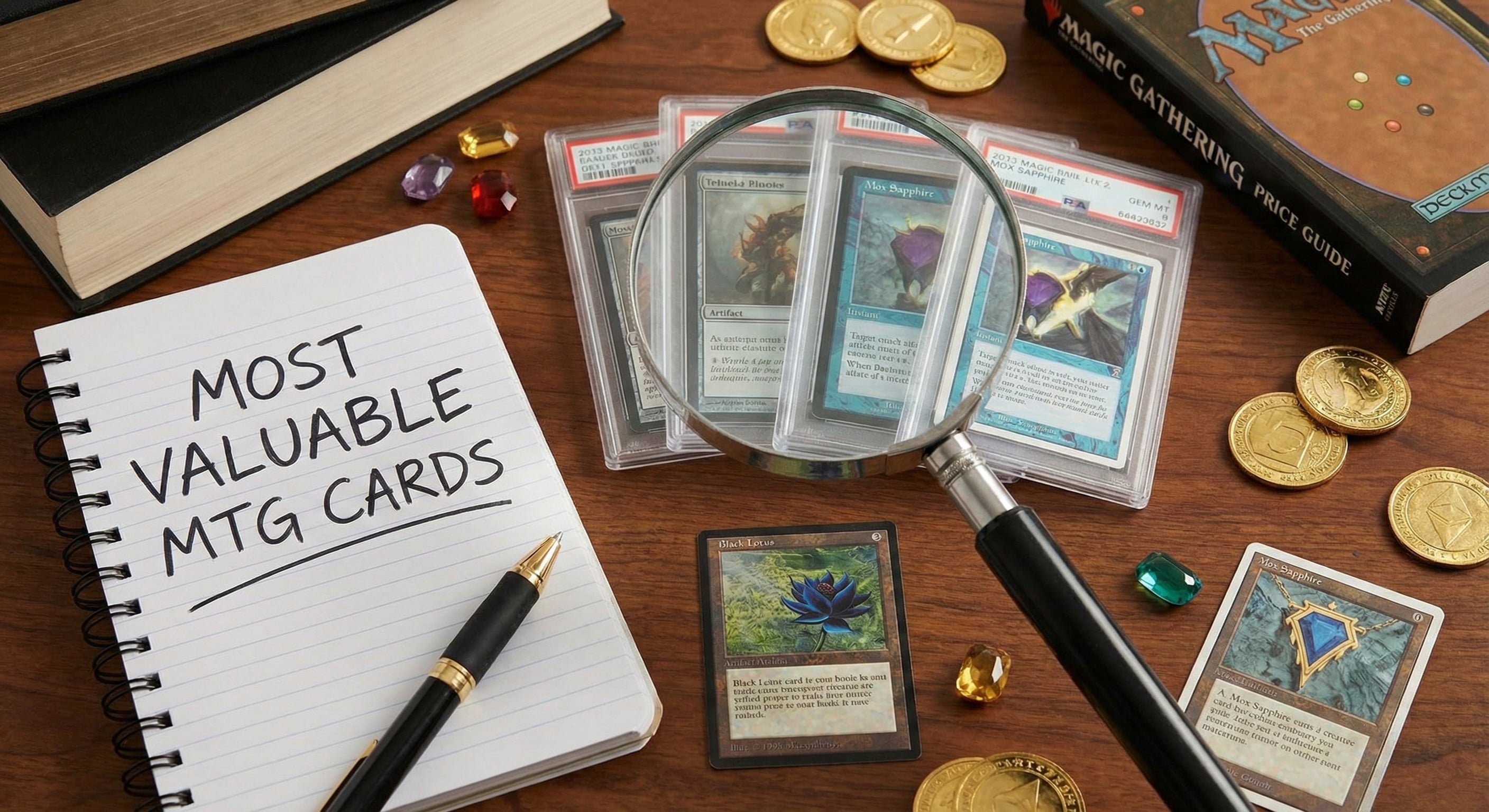
Quick Verdict
The MTG market has evolved into a dual-track economy: Vintage cards like the $3 million Alpha Black Lotus represent stable 'blue chip' assets, while modern serialized cards like The One Ring ($2M+) operate with cryptocurrency-like volatility. This definitive guide covers every tier of value.
TOP CARDS
.jpg)
Alpha Black Lotus (CGC Pristine 10)
Ultimate Grail - The $3 million record holder
- ✓Sold for $3,000,000 in 2024 (record-breaking)
- ✓Protected by Reserved List (never reprinted)
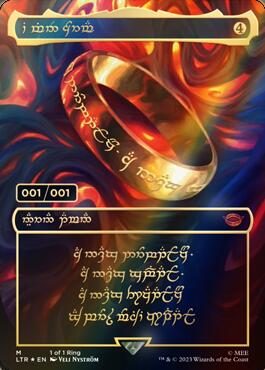
The One Ring (001/001)
Modern Era Benchmark - First 1-of-1 serialized card
- ✓Sold to Post Malone for $2,000,000+
- ✓First global 'Golden Ticket' promotion

Traveling Chocobo (Serialized /77)
IP Crossover Grail - Final Fantasy set lottery card
- ✓Only 77 copies printed
- ✓Sales reaching $78,000+
The most expensive MTG card ever sold is an Alpha Black Lotus graded CGC Pristine 10, which went for $3,000,000 in 2024. Next is The One Ring 001/001, the serialized one-of-one bought by Post Malone for about $2,000,000 in 2023. Below them sit the Power Nine, the true one-of-a-kind cards, and serialized modern cards. This is the full list of the most expensive Magic cards, and why rarity and price aren't the same thing.
The financial landscape of Magic: The Gathering has undergone a radical transformation by 2026, evolving from a singular hobbyist market into a sophisticated, dual-track economy. This bifurcation divides the market into two distinct asset classes: the "Vintage" sector, characterized by organic scarcity, historical provenance, and the immutable Reserved List; and the "Modern" sector, defined by "manufactured rarity," aggressive intellectual property (IP) integration, and high-velocity serialization.
As of early 2026, the capitalization of the total Magic: The Gathering secondary market has reached unprecedented heights, driven by record-breaking sales such as the $3 million Alpha Black Lotus and the multi-million dollar transaction for The One Ring (001/001). These marquee sales have validated trading cards as a legitimate alternative asset class, comparable to fine art, vintage wine, or luxury timepieces.
In this comprehensive market analysis, we'll explore every tier of value in the MTG ecosystem—from the $3 million Alpha Black Lotus to the serialized lottery cards of the modern era. This guide synthesizes auction results, private treaty sales, and market sentiment from 2024 through early 2026 to establish a definitive valuation hierarchy.
The Rarest Magic: The Gathering Cards (Rarity and Price Are Different Questions)
"Rarest" and "most valuable" get used interchangeably, and they are not the same measurement. Rarity is a count of how many exist. Price is a count of how many people want one. The two correlate at the top of the market and come apart almost everywhere else.
The direct answer: the rarest Magic cards are the true 1-of-1s — the 1996 World Champion, the Shichifukujin Dragon, and The One Ring (001/001). Of those, the Shichifukujin Dragon is arguably the rarest thing in the game in any practical sense: only one exists, and it is held permanently by a corporation rather than a collector, so it cannot be bought at any price.
Below the 1-of-1s, scarcity runs in tiers:
| Tier | Surviving population | Examples |
|---|---|---|
| True 1-of-1s | 1 | 1996 World Champion, Shichifukujin Dragon, The One Ring 001/001 |
| Private commemoratives | ~9 to ~220 | Proposal, Splendid Genesis, Fraternal Exaltation, Phoenix Heart |
| Printing accidents | Unknown, very low | Summer Magic "Blue Hurricane", major miscuts, inverted backs |
| Modern serialized | 77 to 500 | Traveling Chocobo /77, serialized Praetors /500 |
| Alpha rares | ~1,100 printed, fewer surviving | Black Lotus, the Moxen, Ancestral Recall |
Why rarity alone does not set the price
Plenty of genuinely scarce cards are close to worthless. Obscure promos, foreign-language misprints and low-population oddities from unloved sets can be rarer than an Alpha Black Lotus and trade for a few hundred dollars, because scarcity only converts into price when there is a competing pool of buyers who want that specific card.
This is why the Power Nine outperforms rarer cards, and why a serialized card from a popular crossover can outprice a 1990s promo with a fraction of its population. Demand is the multiplier; rarity is only the base.
The rest of this guide is ordered by price rather than population, because price is what you can act on. Where the two diverge sharply, the section says so.
The Apex of Valuation: Unique and One-of-a-Kind Assets
At the absolute zenith of Magic: The Gathering collecting lie assets that exist in quantities of one, or so few that they effectively never enter the public sphere. These items are valued not merely for their gameplay utility or their scarcity, but as unique historical artifacts that represent pivotal moments in the game's thirty-plus-year history.
The One Ring (Serialized 001/001)
Era: Modern (2023)
Set: The Lord of the Rings: Tales of Middle-earth
Estimated Valuation: $2,000,000+
The printing and subsequent sale of The One Ring (Serialized 001/001) in 2023 marked a paradigm shift in Wizards of the Coast's product strategy. It was the first instance of a "Golden Ticket" promotion on a global scale, introducing sports-card-style singularity to a game traditionally driven by functional deck-building components.
Provenance and Discovery: The card's existence created a global treasure hunt, driving the sales of The Lord of the Rings: Tales of Middle-earth Collector Boosters to historic levels. The statistical probability of opening the card was calculated at less than 0.00003%. The asset was eventually discovered by a retail worker and collector named Brook Trafton in Whitby, Ontario.
The Transaction: The card was purchased by Austin Richard Post, known professionally as Post Malone, a recording artist and prominent figure in the Magic community. The transaction price was reported as approximately $2 million USD (with some sources citing $2.64 million CAD). This sale established a new ceiling for modern cards, proving that "manufactured rarity"—artificially limiting a print run to a single copy—could compete with the organic rarity of 1993 Alpha cards.
The Cultural Impact
The One Ring remains the most expensive card ever sold from a modern expansion and serves as the benchmark for all subsequent serialized cards. It features the text of the Ring inscribed in the Black Speech of Sauron using Tengwar letterforms, and unlike other versions of The One Ring, it is a traditional foil with no other mechanical variants.
1996 World Champion
Era: Vintage (1996)
Set: Unique Promotional Print
Estimated Valuation: Priceless / Speculative ($200,000 - $1,000,000+)
While The One Ring is a product of modern marketing precision, the 1996 World Champion is a relic of the game's competitive heritage. It stands as a testament to the era when Magic was establishing itself as the world's premier strategy game.
Design and Destruction: The card was created solely for the winner of the 1996 World Championships held in Seattle. Illustrated by Christopher Rush, the legendary artist behind the Black Lotus, the card features artwork of a stylized summoner and unique mechanics. Crucially, to ensure its absolute uniqueness, Wizards of the Coast ceremonially destroyed the printing plates and all test copies after the single final card was produced. This act of destruction was filmed, cementing the card's status as a true "1 of 1" long before serialization existed.
Ownership History: The card was awarded to Tom Chanpheng of Australia, who won the championship playing a White Weenie deck. In 2001, Chanpheng sold the card to a private collector for $17,500—a sum that appears trivial in the context of the 2026 market. The card is currently believed to be encased in a screw-down trophy display, effectively removing it from circulation.
Shichifukujin Dragon
Era: Vintage (1996)
Set: DCI Tournament Center Promo
Estimated Valuation: Priceless / Institutional Asset
The Shichifukujin Dragon shares the rarefied air of the 1996 World Champion but serves a different purpose: it was a cultural bridge. It was created to celebrate the opening of the DCI Tournament Center in Tokyo, Japan, marking Magic's expansion into the Asian market.
Cultural Significance: The card's name refers to the "Seven Deities of Good Luck" in Japanese mythology. It was designed by Mark Rosewater, who reportedly had only an hour to finalize the mechanics, and illustrated by Christopher Rush. The card features a cost of {6}{R}{R}{R} and enters the battlefield with seven +1/+1 counters, representing the seven deities.
Current Location: Only one copy exists. Unlike the 1996 World Champion, which entered private hands, the Shichifukujin Dragon has remained an institutional asset. Following the closure of the DCI Tournament Center in 2003, the card was moved to the Head Office of Hobby Japan, where it resides permanently. Because it is held by a corporation rather than a private individual, it is effectively removed from the market.
The Garfield Celebration Cards: Personal History as Asset Class
A unique and deeply personal sub-category of valuation involves cards created by Magic's creator, Richard Garfield, to commemorate significant events in his life. These cards were never available in booster packs; they were distributed strictly to friends, family, and Wizards of the Coast staff.
Proposal
Event: Marriage Proposal to Lily Wu (1993)
Estimated Valuation: $50,000 - $100,000+
In 1993, Richard Garfield approached production manager Dave Howell to create a card specifically for his marriage proposal to Lily Wu. To maintain secrecy, the card was printed on a small sheet rather than a full press run. The artist, Quinton Hoover, illustrated a distinctive image for the occasion.
The Proposal: During a game of Magic, Garfield allegedly played the card, which had the text "Target opponent becomes my wife" (paraphrased). It reportedly took four games for Garfield to draw the card and play it.
Scarcity: It is estimated that only nine copies were made initially for the proposal event, though some sources suggest a slightly higher number for family distribution. Regardless, the number is vanishingly small.
Market Activity
Copies are exceptionally rare and almost never surface. A copy appeared for sale in Paris in 2017 with an asking price of $50,000, though the final sale price and buyer remain undisclosed. In the 2025/2026 market, a verified copy would be considered a "Grail" item, likely exceeding $100,000 due to its connection to the game's genesis.
Splendid Genesis
Event: Birth of first child, Terry (1997)
Estimated Valuation: $21,600 - $72,000
This card was created to announce the birth of Garfield's first child, Terry. It had a slightly larger print run than Proposal, estimated at approximately 110 copies, which were mailed to friends and colleagues.
Valuation: High-grade copies (BGS 8.5+) have tracked upwards of $21,600, with pristine examples listed significantly higher, reaching up to $72,000 in asking price. It is the most "common" of the ultra-rare Garfield cards but remains scarcer than any Alpha rare, making it a key target for completionist collectors.
Fraternal Exaltation
Event: Birth of second child, Schuyler (1999)
Estimated Valuation: ~$80,000 - $85,000
With a print run estimated around 220 copies, this card celebrates the birth of Garfield's second son. Despite being strictly more numerous than Proposal or Splendid Genesis, its scarcity still drives immense value.
Market Position
Recent market analysis places near-mint copies in the range of €80,000 (approx. $85,000 USD), reflecting the deep pockets of "Old School" collectors completing their portfolios. The card features a unique mechanic ("Sneak a peek at target opponent's hand") and art depicting the two siblings.
Phoenix Heart
Event: Second Marriage (2015)
Estimated Valuation: $35,000 - $50,000
Created for Garfield's second marriage to Koni Kim, this card features the mechanic "Koni and Richard continue the game and play all games as partners forever". It is the most recent of the "celebration" cards.
Sales Data: Private listings for WotC employee-owned copies have appeared with asking prices of $50,000, with minimum offers of $35,000 being entertained by high-end brokers.
The Power Nine and The Reserved List: The Gold Standard
While unique cards are anomalies, the "Power Nine" from the original Limited Edition Alpha (1993) set represent the foundational bedrock of the MTG investment market. These cards are protected by the Reserved List, a promise by Wizards of the Coast never to reprint them, ensuring their supply is permanently capped.
Alpha Black Lotus
Estimated Value (Pristine/Gem Mint 10): $3,000,000
Estimated Value (PSA 9): $500,000 - $600,000
Estimated Value (Played): $38,000 - $100,000
The Black Lotus remains the undisputed icon of the hobby. Its value is derived from its unmatched utility (providing three mana of any color for zero cost) and its status as the ultimate symbol of collectible gaming. For the full picture on this card specifically — every printing that exists, what each is worth, and the tests that separate a genuine copy from a rebacked counterfeit — see our complete guide to Black Lotus.
The $3 Million Record: In 2024, a CGC Pristine 10 Alpha Black Lotus sold for $3 million in a private transaction brokered by Adam Cai of Pristine Collectibles. This sale shattered previous records, surpassing even the Post Malone One Ring purchase. The "Pristine 10" grade signifies a card that is virtually flawless, a statistical impossibility for a card printed in 1993 when sleeves were not used and decks were riffle-shuffled.
The population of Alpha Black Lotuses is extremely low (approximately 1,100 printed), and those surviving in perfect condition are nearly non-existent. The $3 million price tag reflects the uniqueness of this grade; a PSA 9 copy trades for significantly less, typically in the mid-six figures. Additionally, Artist Proofs—white-backed cards given to the artist—have their own market. A Beta Black Lotus Artist Proof, signed by the late Christopher Rush, sold for $615,000, with reports of Post Malone purchasing a similar proof for $800,000.
Alpha Black Lotus (CGC Pristine 10)
Sold for $3,000,000 in 2024, setting the record for the most expensive MTG card. Protected by Reserved List. Only ~1,100 Alpha copies ever printed. Pristine 10 grade is virtually impossible.
The Moxen (Alpha)
The five Moxen (Sapphire, Jet, Ruby, Emerald, Pearl) are artifacts that function as lands, providing mana acceleration that breaks the game's fundamental resource curve.
Mox Sapphire (Alpha PSA 10): Speculative $1,000,000+ (None sold recently)
Mox Sapphire (Alpha PSA 9): ~$46,800 - $100,000+
Mox Jet (Alpha PSA 10): ~$108,000
Mox Sapphire: Traditionally the most valuable Mox due to the dominance of Blue in the Vintage format (powering Ancestral Recall and Time Walk). High-grade copies are exceedingly difficult to find. A PSA 9 recently tracked around $46,800, though market listings for higher grades push well into six figures.
Mox Jet: A PSA 10 Gem Mint Alpha Mox Jet is valued at approximately $108,000. The popularity of Black in "Old School" formats maintains its position as the second most desirable Mox.
Ancestral Recall and Time Walk (Alpha)
Ancestral Recall (Alpha): ~$10,900 (High Grade Sales) - $37,000+ (Gem Mint estimates)
Time Walk (Alpha PSA 10): ~$63,000
Ancestral Recall: Drawing three cards for one mana is considered the most powerful effect in the game. While listed prices fluctuate, high-grade Alpha copies command massive premiums. Recent sales data for PSA 10s is sparse, but PSA 9s and near-mint raw copies consistently trend upward.
Time Walk: Taking an extra turn for two mana is iconic. A PSA 10 Alpha Time Walk holds a valuation of roughly $63,000.
High-End Non-Power Alpha Rares
The market in 2025 has seen significant appreciation for iconic Alpha rares that are not part of the Power Nine but possess immense nostalgic and collectible value.
- Lord of the Pit (Alpha BGS 10): $105,000. This sale highlights the premium placed on "perfect" grades for iconic art, even if the card itself is not tournament viable.
- Vesuvan Doppelganger (Alpha BGS 9.5): $63,000. A favorite among collectors for its distinct Quinton Hoover art and complexity.
- Timetwister (Alpha PSA 10): $84,000. As the only "Power Nine" card legal in the Commander format (EDH), Timetwister has unique demand drivers.
The Era of Manufactured Rarity: Serialized Cards (2023-2026)
Beginning with The One Ring, Wizards of the Coast shifted strategies to target the high-end collector market through serialization. This "Modern Era" of collecting is characterized by high volatility, driven by IP crossovers and lottery-style pull rates.
The "Traveling Chocobo" (Final Fantasy Set)
Era: 2025 Card Name: Traveling Chocobo (Serialized Borderless Gold) Estimated Value: $50,000 - $78,000+
The 2025 Universes Beyond: Final Fantasy set introduced the "Traveling Chocobo," a serialized run limited to 77 copies. This extremely low print run was a nod to the "Lucky 7s" often associated with the Final Fantasy franchise. For more on how the Final Fantasy set impacts the Commander format, see our complete formats guide.
Market Frenzy: The "Traveling Chocobo" triggered a massive collector rush. Unlike the 1/1 One Ring, the print run of 77 allowed for a partially active market, creating a "race to the bottom" or "race to the top" depending on the serial number.
Sales Performance: Confirmed sales include a copy selling for $50,000 shortly after release, with subsequent sales of specific serial numbers (e.g., #53/77) reaching $78,000.
Speculative Bubble
Listings for high-grade copies (Pristine 10s) have appeared with asking prices as high as $250,000, though realized sales at this level are unconfirmed. This demonstrates the intense speculative bubble surrounding top-tier IP crossovers.
Serialized Praetors (March of the Machine)
Card: Elesh Norn, Grand Cenobite (Serialized /500)
Estimated Value: $1,300 - $4,000
Performance: The March of the Machine serialized Praetors were among the first tests of the /500 serialization model. While valuable, they have not maintained the astronomical highs of the 1/1 or /77 cards.
Market Correction: Prices for these cards have stabilized. An Elesh Norn serialized card can be found for approximately $1,300 to $4,000 depending on the specific number (e.g., #001 or #500 command premiums) and grade. This suggests a "saturation point" for serialization where higher print runs (/500) dilute the "Grail" status.
Viscera Seer (Reversed Serialization)
Card: Viscera Seer (Serialized /100)
Estimated Value: $2,500 - $8,000
Mechanism: A unique promotion where the serialization was reversed (e.g., #100 is the first printed).
Value: Due to the extremely low run (100 copies) and the novelty, these cards command significantly higher prices than the /500 Praetors, with listings reaching $8,000 for high grades.
Ravnica Remastered Serialized Shock Lands
Cards: Steam Vents, Overgrown Tomb, etc. (Serialized /500)
Estimated Value: $300 - $2,000
Market Analysis: These cards represent the "entry-level" of the serialized market. While a serialized Godless Shrine might fetch $2,000, less popular cards or higher serial numbers often trade in the $300-$600 range. This data reinforces that the card's playability (Shock Lands are staples) combined with rarity drives value, but /500 is not scarce enough to guarantee five-figure prices.
Traveling Chocobo (Serialized /77)
Only 77 copies printed. Sales reaching $78,000+. Final Fantasy IP crossover appeal with active secondary market. Subject to hype cycles.

Encore Electromancer (Miku Snapcaster)
Ultra-rare bonus card from Hatsune Miku Secret Lair. Trades for $900-1,500. Unannounced rarity drove sealed product sales. One of the most valuable Secret Lair cards.
The Secret Lair Phenomenon & The "Bonus Card" Economy
The integration of third-party IP (Marvel, Final Fantasy, Hatsune Miku) has become the primary revenue driver for Hasbro's digital and tabletop gaming segments in 2025. This strategy has created complex sub-markets with unique valuation rules, particularly regarding "Bonus Cards"—unannounced cards included in Secret Lair drops. For a worked example of how one drop's market behaved, see our Stranger Things Secret Lair guide, and for a full Universes Beyond set built around serialized historical figures, the Assassin's Creed collector guide.
The Hatsune Miku Saga (2024-2025)
The collaboration with Crypton Future Media for the Hatsune Miku Secret Lair series became one of the most controversial and financially volatile events of the period. Our complete guide to the Hatsune Miku Secret Lair collaboration covers all four drops in detail. The release spanned four "seasons": Sakura Superstar (Spring), Digital Sensation (Summer), Electric Entourage (Fall), and Winter Diva (Winter).
The "Snapcaster" Lottery: The primary driver of value in this series was the discovery of a rare "lottery" bonus card: Encore Electromancer, a reskinned version of the Modern and Legacy staple Snapcaster Mage.
Scarcity Mechanics: Unlike typical bonus cards (e.g., Elvish Mystic or Command Tower which were guaranteed in certain drops), the Encore Electromancer appeared at a much lower frequency, reportedly replacing the standard bonus card in a small percentage of boxes across the drops.
Market Chaos: Confusion peaked during the Winter Diva drop. Leaks suggested Snapcaster Mage would be the guaranteed bonus, but early openings revealed Beloved Princess (a bulk common) as the standard bonus, causing panic. However, it was later confirmed that Encore Electromancer was still a potential, albeit incredibly rare, pull.
Valuation: Confirmed copies of Encore Electromancer trade between $900 and $1,500 on the secondary market, making it one of the most valuable Secret Lair cards ever produced. This incident highlighted the value of "unannounced rarity" in driving sales of sealed product.
Marvel Secret Lair (Spider-Man, Iron Man, Wolverine)
Era: 2024-2025
Key Asset: Cosmic Foil Sol Ring (Soul Stone variant)
Estimated Value: $10,000+
Cosmic Foil Rarity: The Marvel's Spider-Man set introduced "Cosmic Foil" variants, a treatment reserved for the rarest inserts. The Sol Ring in this treatment (featuring the Soul Stone/Infinity Stone design) has been recorded selling for over $10,000 immediately upon release, driven by the crossover appeal of the Marvel Cinematic Universe fanbase entering the MTG market.
Standard Cards: In contrast, non-serialized, standard foil chase cards from these sets, such as Wolverine, Best There Is and Iron Man, Titan of Innovation, trade in the relatively accessible $20-$70 range. This indicates that without serialization or special foiling technologies (like Cosmic Foil), mass-produced IP cards have a hard value ceiling, regardless of the character's popularity.
Misprints and Oddities: The "Blue Hurricane"
While not a deliberate product, the "Summer Magic" (Code name: Edgar) print run of 1994 contains one of the most famous misprints in gaming history.
Summer Magic "Blue Hurricane"
Era: 1994 (Summer Magic / Edgar)
Estimated Value: $5,300 - $8,500+
The Error: In 1994, WotC attempted to fix the washed-out colors of the Revised Edition. The resulting print run, "Summer Magic," was too dark and had numerous errors. The entire run was recalled and destroyed, but a few cases survived and entered circulation. The most iconic error is the green card Hurricane, which was accidentally printed with a blue border.
The Blue Mauritius of MTG
Near Mint copies are listed for $8,500, with recent sales oscillating between $5,300 and $7,000 depending on condition. This makes it the "Blue Mauritius" of MTG—a stamp collecting equivalent of a legendary error that transcends the game itself.
Comparative Valuation: Vintage vs. Modern
The following analysis synthesizes the valuation data to compare the two dominant asset classes in the 2025-2026 market.
| Asset Class | Key Representative | Primary Value Driver | 2025/2026 Peak Valuation | Liquidity Profile |
|---|---|---|---|---|
| Vintage (Alpha) | Black Lotus (Pristine 10) | Historical Significance, Condition Scarcity | $3,000,000 | Low (Private Treaty) |
| Vintage (Alpha) | Black Lotus (Played) | Gameplay Utility, Iconography | $38,000–$100,000 | High (Auctions/Vendors) |
| Modern (Serialized) | The One Ring (001/001) | Unique IP, Artificial Scarcity | $2,000,000+ | Extremely Low (Unique) |
| Modern (Serialized) | Traveling Chocobo (/77) | IP Fandom, Limited Print Run | $78,000 | Medium (High Volatility) |
| Promo/Unique | 1996 World Champion | Absolute Singularity (1 of 1) | Speculative ($1M+) | Illiquid (Museum Piece) |
| Promo/Garfield | Fraternal Exaltation | Creator Provenance | ~$80,000 | Low (Collector to Collector) |
| Secret Lair Bonus | Encore Electromancer | Unannounced Rarity | $1,500 | Medium |
| Misprint | Blue Hurricane | Notoriety, Rarity | ~$8,500 | Medium |
Insight: The Divergence of "True" vs. "Manufactured" Rarity
Critical Market Distinction
The data suggests a critical distinction in long-term value retention. Vintage Cards like the Black Lotus and Ancestral Recall have shown a steady, compounding appreciation over 30 years. Their rarity is organic—resulting from low initial print runs and the attrition of time (loss, damage). The premium for condition (PSA 10) has detached completely from the "raw" card price, turning high-grade slabs into art assets comparable to fine paintings.
Modern Serialized Cards operate more like cryptocurrency or high-volatility stocks. The Traveling Chocobo spiking to $78,000 is driven by immediate "hype cycles" surrounding the Final Fantasy set release. While The One Ring (001/001) is likely to hold value due to its "first of its kind" status and Tolkien IP, lower-tier serialized cards (e.g., /500 Praetors) have already seen price correction.
Market Outlook 2026: Trends and Risks
As we look toward the future of the MTG collectibles market, several key trends and risks emerge that will shape the landscape in 2026 and beyond.
Corporate Strategy and Revenue Reliance
Hasbro's financial reports from late 2025 indicate a heavy reliance on Magic: The Gathering to drive revenue, specifically through the "Universes Beyond" strategy. Revenue from MTG increased by a staggering 55% in Q3 2025, fueled by Final Fantasy and Marvel collaborations.
Implication: The market will continue to be flooded with high-end, limited-edition IP cards. This creates a risk of "wallet fatigue" among collectors. As new "shiny objects" appear quarterly (e.g., the next major IP collaboration), the mid-tier market ($500-$5,000 serialized cards) may soften as capital shifts to the newest release.
The "Old School" Safe Haven and The Reserved List
As modern product saturation increases, seasoned investors are retreating to the safety of the Reserved List. The Reserved List guarantees that specific cards like Dual Lands (Underground Sea, Volcanic Island), Mishra's Workshop, and the Power Nine will never be reprinted.
Inflation Hedge
Underground Sea (Alpha) continues to command prices upwards of $13,000 for high-grade copies, and Mishra's Workshop remains a multi-thousand-dollar staple. These assets are viewed as inflation hedges, immune to the reprinting policies that affect modern cards. The market sentiment for 2026 suggests a continued "flight to quality" where investors prioritize assets that cannot be devalued by future print runs.
Grading as the Kingmaker
The $3 million sale of the CGC Pristine 10 Black Lotus has cemented the role of grading companies (PSA, BGS, CGC, TAG) as the ultimate arbiters of value. In 2026, the difference between a "9" and a "10" is no longer a percentage point—it is a multiplier of 5x to 10x.
A notable trend in 2026 is the "crack and resubmit" game. Collectors are increasingly cracking "old label" slabs to resubmit to services like CGC or TAG in hopes of achieving "Pristine" or "Black Label" designations, which are now the primary drivers of record-breaking sales. This creates a micro-economy of grading speculation within the larger card market.
Conclusion: The Dual-Track Economy
The landscape of the most valuable Magic: The Gathering cards in 2026 is defined by a dichotomy of value. On one side stands the Alpha Black Lotus, the immutable king of the hobby, whose value is anchored in thirty years of history, organic scarcity, and the unshakeable promise of the Reserved List.
On the other stands The One Ring and its serialized successors (Traveling Chocobo from the Final Fantasy set, Cosmic Foil Sol Ring), representing a new era of "manufactured" value driven by global IP brands and lottery mechanics.
For the investor, the Vintage market offers stability and "blue chip" safety. The Modern market offers high-risk, high-reward opportunities, where hitting a "lottery card" like a serialized Elesh Norn or a Traveling Chocobo can yield immediate five-to-six-figure returns, provided the asset is liquidated before the next hype cycle begins.
The market has spoken: Magic: The Gathering cards are now a legitimate alternative asset class, with valuations rivaling fine art and luxury collectibles. The question is not whether cards are valuable, but which cards will retain that value over time.
External References
Detailed Comparison
| Asset Class | Key Representative | Primary Value Driver | 2025/2026 Peak Valuation | Liquidity Profile |
|---|---|---|---|---|
| Vintage (Alpha) | Black Lotus (Pristine 10) | Historical Significance, Condition Scarcity | $3M | Low (Private Treaty) |
| Vintage (Alpha) | Black Lotus (Played) | Gameplay Utility, Iconography | $38K–$100K | High (Auctions/Vendors) |
| Modern (Serialized) | The One Ring (001/001) | Unique IP, Artificial Scarcity | $2M+ | Extremely Low (Unique) |
| Modern (Serialized) | Traveling Chocobo (/77) | IP Fandom, Limited Print Run | $78K | Medium (High Volatility) |
| Promo/Unique | 1996 World Champion | Absolute Singularity (1 of 1) | Speculative ($1M+) | Illiquid (Museum Piece) |
Frequently Asked Questions
🔗 Related Resources
More Reviews:
Related Articles

MTG Star Trek: Release Date, Products and What to Preorder
MTG Star Trek releases 13 November 2026. Every product, its MSRP, what it costs to preorder on TCGplayer today, and which ones are worth buying early.
Flashback MTG: What It Means, Rules and Best Cards (2026)
Flashback in MTG lets you cast an instant or sorcery from your graveyard for its flashback cost, then exile it. Full flashback rules and the best cards.
The Ring Tempts You MTG: Rules, 4 Levels, Best Cards (2026)
The Ring tempts you in MTG gives you an emblem and a Ring-bearer that gets stronger each time. All four levels, the rules, and the best Ring cards.