
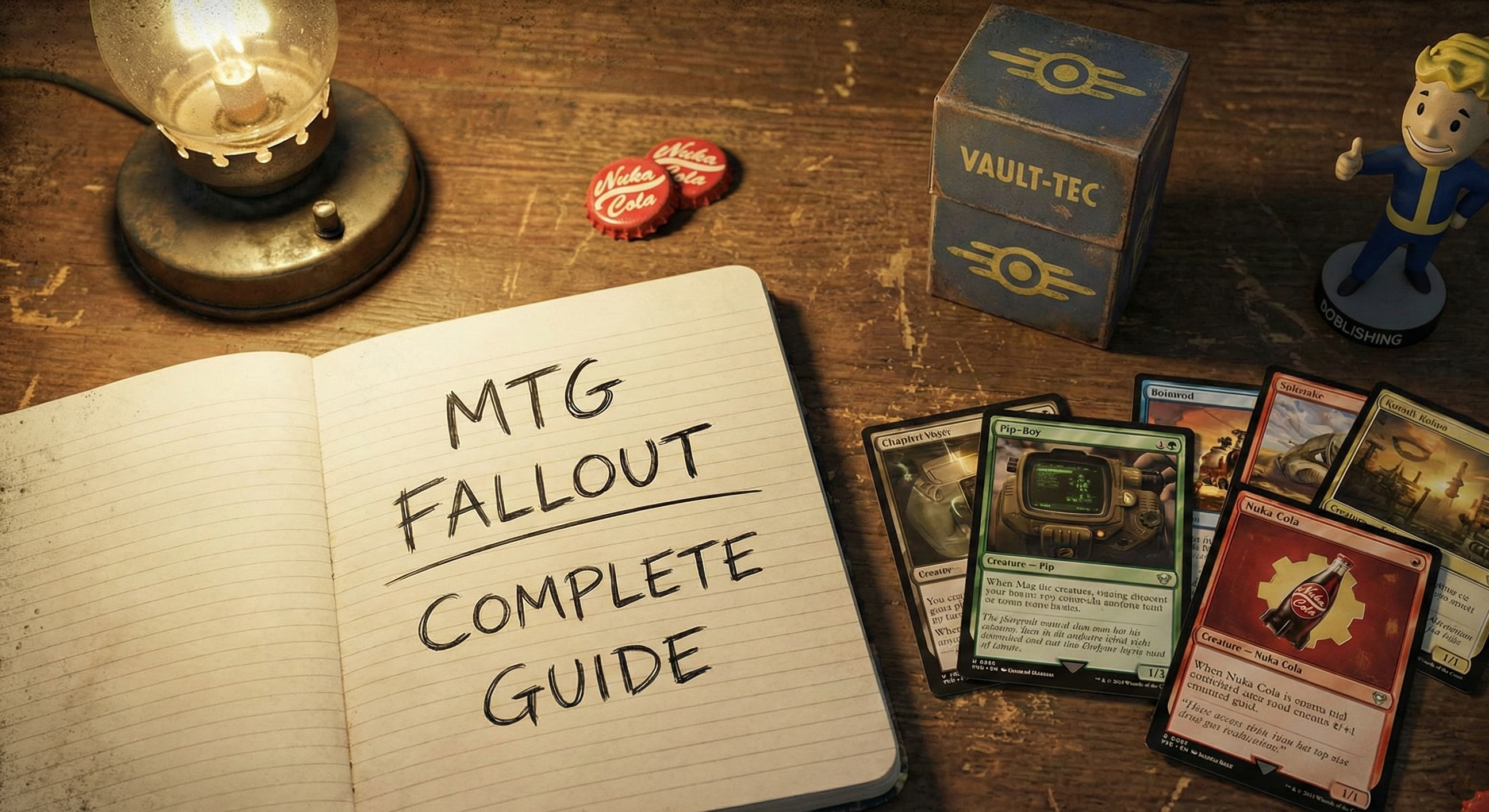

Quick Verdict
The Fallout Commander set introduced revolutionary mechanics like Rad counters and Junk tokens, with commanders like The Wise Mothman achieving staple status. This definitive guide covers all four decks, upgrade strategies, and the serialized Bobblehead collector market.
TOP RECOMMENDATIONS
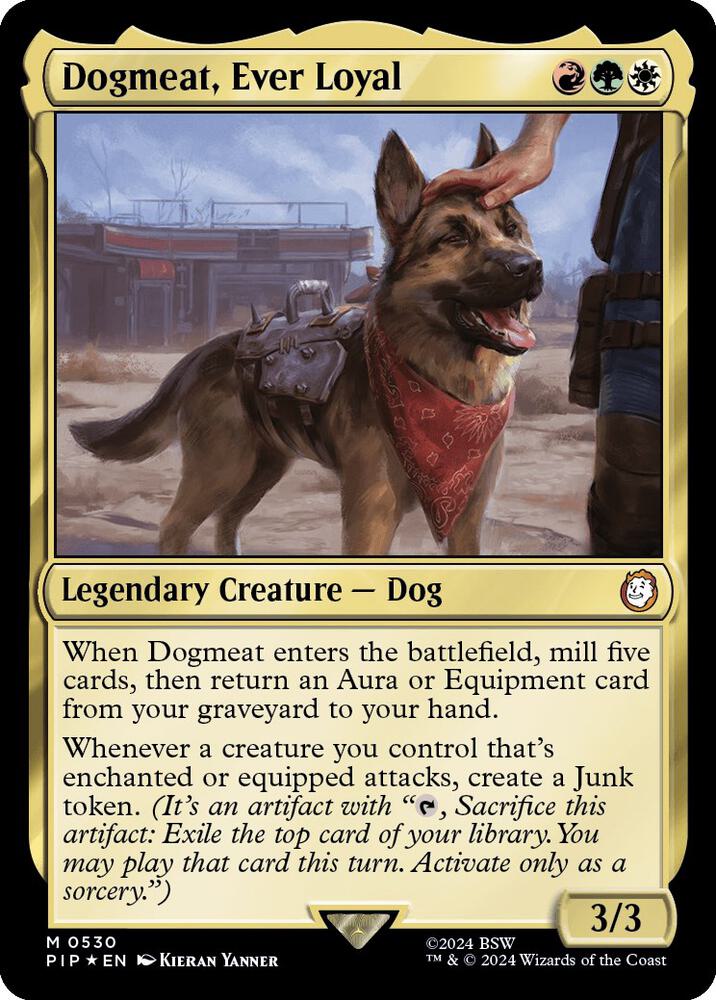
Dogmeat, Ever Loyal
Voltron Commander - 3-mana value engine that generates Junk tokens
- ✓Generates Junk tokens and recurs Auras/Equipment
- ✓Focus on protection and equipment
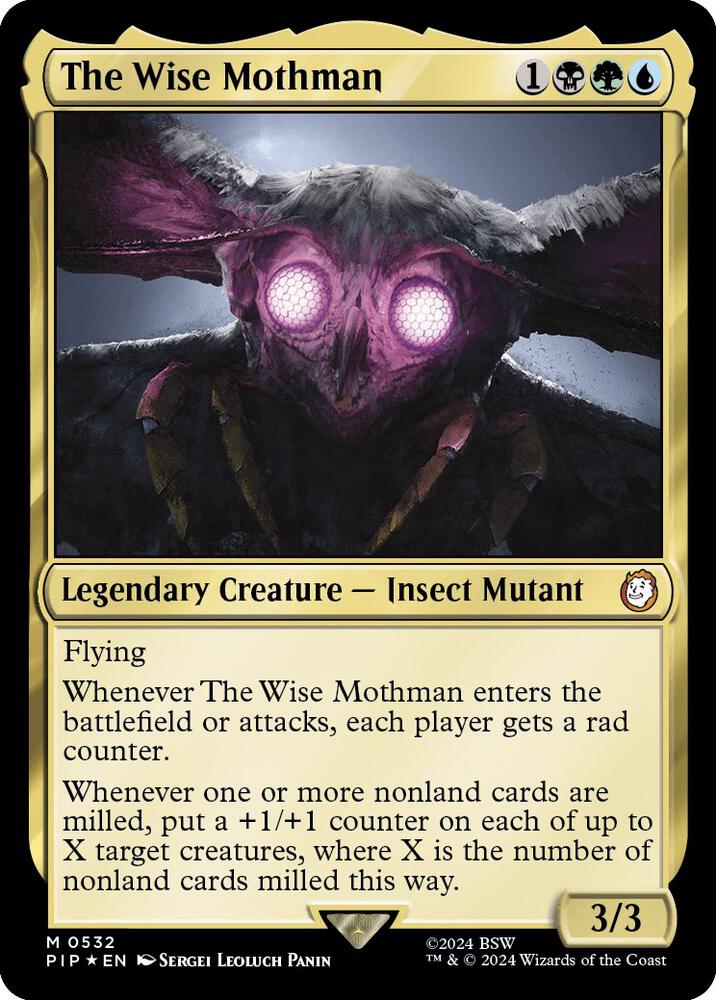
The Wise Mothman
Top Tier Commander - Ranked #13 overall in EDHRec
- ✓Distributes Rad counters and grows creatures
- ✓Grows whenever cards are milled
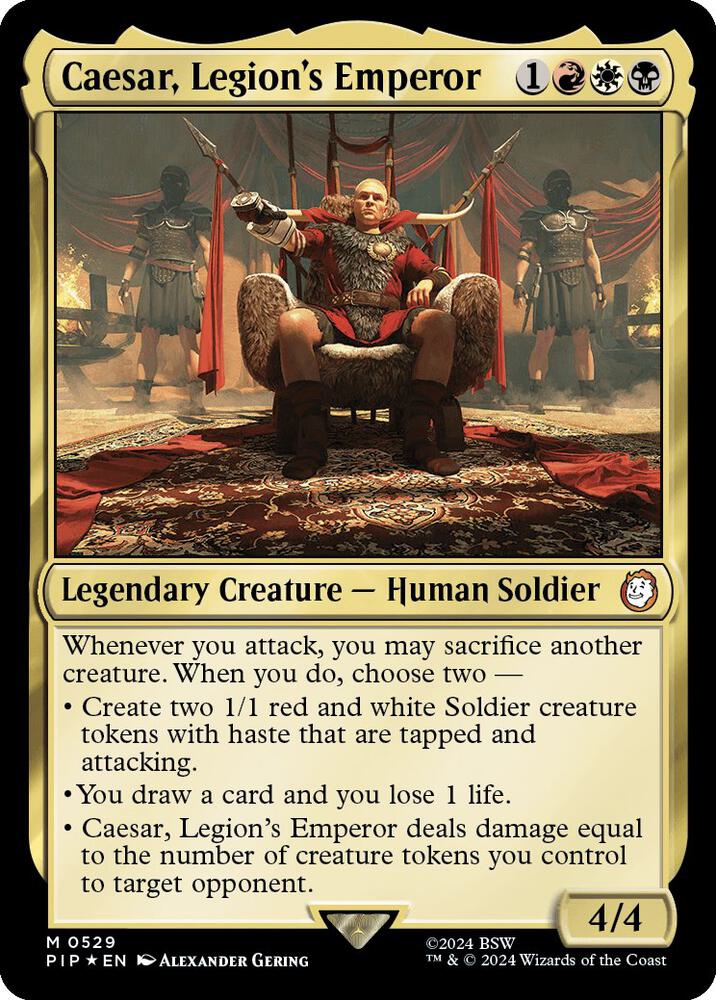
Caesar, Legion's Emperor
Aristocrats Commander - Modal value engine for aggressive strategies
- ✓Generates tokens, draws cards, and deals damage
- ✓Excellent for aggressive go-wide strategies
.jpg)
Serialized Bobblehead (Strength/Luck)
Ultimate Collector Item - Limited to 500 copies each
- ✓Limited to 500 copies per stat
- ✓Crossover appeal with Fallout collectors
SAFETY TECHNOLOGY Expert Analysis.
The collaboration between Wizards of the Coast and Bethesda Softworks, culminating in the release of Magic: The Gathering – Fallout on March 8, 2024, represents a watershed moment in the "Universes Beyond" product line. This set transports the desolate, irradiated aesthetic of the post-apocalyptic role-playing game franchise into the structured tactical environment of Magic: The Gathering.
Unlike traditional expansion sets designed for draft or standard play, Fallout was engineered exclusively as a Commander-focused product, comprising four preconstructed decks and a supplemental run of Collector Boosters. Two years post-release, the set has matured into a cornerstone of the casual meta, with commanders like The Wise Mothman and Caesar, Legion's Emperor achieving "staple" status in the EDHRec rankings.
In this comprehensive guide, we'll explore all four Commander decks, analyze the revolutionary Rad counter and Junk token mechanics, examine upgrade strategies, and provide financial insights into the serialized Bobblehead collector market.
Product Architecture: The Commander-Centric Release Model
The Fallout release strategy adhered to the precedent established by the Warhammer 40,000 collaboration, eschewing the randomized booster pack model for the primary card distribution. Instead, the core functional components of the set were distributed via four fixed-list Commander decks.
This model democratizes access to game pieces, ensuring that players purchasing the decks obtain a near-complete playset of the mechanical content. However, unlike standard sets, Fallout did not feature a corresponding "Draft" or "Set" booster environment. This absence of a limited format placed the entire burden of supply on the preconstructed decks and the premium Collector Boosters, creating scarcity dynamics that have had profound implications for the secondary market.
The Four Pillars of the Wasteland
Scrappy Survivors (Naya - Red/Green/White): A deck built around the "Voltron" archetype, focusing on Auras, Equipment, and the new Junk mechanic. It emphasizes the scavenging nature of the protagonist (the Sole Survivor) and their companion, Dogmeat.
Mutant Menace (Sultai - Black/Green/Blue): A graveyard-centric deck utilizing the new Radiation mechanic to fuel self-mill and reanimation strategies, led by The Wise Mothman.
Hail, Caesar (Mardu - Red/White/Black): An "Aristocrats" strategy focusing on token generation and sacrificial value, mirroring the ruthless military hierarchy of Caesar's Legion.
Science! (Jeskai - Blue/White/Red): An artifact synergy deck that reintroduces Energy counters as a primary resource, representing the high-tech factions of the Brotherhood of Steel and the Institute.
Mechanical Innovation: Rad Counters, Junk Tokens, and Energy
The translation of Fallout's real-time and turn-based RPG mechanics into MTG keywords demonstrates a sophisticated alignment of ludonarrative elements. The design team employed a mix of counters, tokens, and returning keywords to simulate the resource scarcity and environmental hazards of the post-nuclear setting.
Rad Counters (Radiation)
The defining mechanic of the set is the Rad counter, a new type of player counter that imposes a "ticking clock" mechanic representing radiation poisoning.
Mechanical Function: A player with Rad counters must mill cards equal to the number of counters they possess at the beginning of their precombat main phase. For each non-land card milled this way, the player loses 1 life and removes one Rad counter.
Strategic Analysis: Inevitability vs. Variance
Unlike Poison counters, which are binary (alive/dead), Rad counters function as a damage-over-time (DoT) effect. The variance lies in the mill; a player might mill five lands and take no damage, or mill five spells and take 5 damage. This introduces a calculated risk element akin to navigating a highly irradiated zone without a hazmat suit.
Graveyard Synergy: While ostensibly a penalty, experienced players utilize Rad counters as a self-enabling engine. Decks utilizing Muldrotha, the Gravetide or The Master, Transcendent actively seek radiation to fill their graveyards with reanimation targets. The mechanic effectively weaponizes the library, turning deck depletion into resource accumulation.
The Proliferate Interaction
Because Rad counters are placed on players, they interact with the Proliferate mechanic. A player with one Rad counter can be proliferated to ten, creating a sudden, lethal mill engine. This interaction is the cornerstone of the Mutant Menace deck's win condition.
Junk Tokens
Reflecting the crafting and scavenging loop of Fallout 4, Junk tokens are a new predefined artifact token.
Mechanical Function: ", Sacrifice this artifact: Exile the top card of your library. You may play that card this turn. Activate only as a sorcery."
Impulsive Draw Economy
Junk provides "impulsive draw" (exiling to play temporarily). This differs from Clue tokens (which draw to hand) by forcing the player to "use it or lose it." This promotes an aggressive, main-phase-centric playstyle typical of Red/White decks.
Sorcery Speed Restriction: The restriction to sorcery speed is a critical balancing lever. It prevents control decks from hoarding Junk to find counterspells on an opponent's turn. Instead, it forces proactive play, rewarding players who tap out to advance their board state.
Artifact Density: Beyond the card advantage, Junk tokens serve as "batteries" for artifact-affinity cards. A card like All That Glitters or Nettlecyst counts Junk tokens towards power/toughness. Smart players will stockpile Junk not to sacrifice it, but to buff a Commander for a lethal swing.
Energy Counters
Returning from the Kaladesh block, Energy () represents the power required for advanced technology like Power Armor, laser weaponry, and Liberty Prime.
Mechanical Function: Energy is a counter on the player that serves as a currency to pay for activated abilities or triggered effects. Unlike mana, it does not empty from the pool as phases end.
Scale Shift from Kaladesh
The Fallout implementation of Energy differs from Kaladesh in scale. While Kaladesh often used Energy for small incremental advantages (thopters, +1/+1 counters), Fallout cards like Liberty Prime, Recharged and Dr. Madison Li use it for massive, game-swinging effects. This shifts the mechanic from "incidental value" to "primary resource management."
Squad
Returning from Warhammer 40,000, Squad represents the recruitment of companions or the deployment of mass-produced units.
Mechanical Function: "Squad " allows a player to pay an additional cost any number of times when casting a creature. For each time the cost is paid, a token copy of that creature is created.
Late Game Scaling
Squad solves the "late game scaling" problem for creature decks. A 2-mana creature with "Squad " is playable on turn 2, but is also a devastating army-in-a-can on turn 10 when you have 8 mana available. In the Hail, Caesar deck, cards with Squad provide instant fodder for sacrifice outlets.
Faction Study: Scrappy Survivors (Naya)
The Scrappy Survivors deck focuses on the Voltron archetype, using Auras and Equipment to turn Dogmeat into a lethal threat while generating Junk tokens for card advantage.
Commander Profile: Dogmeat, Ever Loyal
Dogmeat, Ever Loyal is a 3-mana 3/3 Legendary Dog. Upon entering the battlefield (ETB), he mills five cards and returns an Aura or Equipment from the graveyard to hand. His static ability generates a Junk token whenever a creature you control attacks, provided it is enchanted or equipped.
Tactical Breakdown
Dogmeat is designed as a value engine rather than a lethal threat. Traditional "Voltron" commanders (like Uril, the Miststalker) focus on being untargetable giants. Dogmeat, conversely, focuses on resilience and card advantage. The mill ability ensures that even if Dogmeat is removed, his replacement cost is offset by the card retrieved from the graveyard.
Secondary Commander: Preston Garvey, Minuteman
Preston Garvey shifts the focus from equipment to "Enchanting Lands." His ability allows him to untap enchanted permanents when he attacks. In a deck built around Wild Growth, Fertile Ground, and Market Festival, Preston acts as a massive mana ramp engine, allowing for explosive plays in the second main phase.
Comparison:
- Dogmeat = Aggro/Midrange value. Better for equipment-heavy builds.
- Preston = Ramp/Combo. Better for "Enchantress" builds and big mana finishers.
Upgrade Strategy: The "Goodest Boy" Voltron Build
To optimize Dogmeat, the deck should pivot entirely to maximizing the protection and lethality of a single threat, using Junk to keep the gas pedal down.
See our top picks above for detailed information about Dogmeat, Ever Loyal and other Fallout commanders.
Key Upgrades:
- Swiftfoot Boots: Grants Hexproof; protects the Commander
- Sigarda's Aid: Flashes Auras/Equipment; bypasses sorcery speed
- Puresteel Paladin: Turns every equipment played into a card draw
- Forge Anew: Instant-speed equip and graveyard recursion
- Kediss, Emberclaw Familiar: Multiplies combat damage to all opponents
Recommended Cuts: Brotherhood Scribe, Geneva, Ancient Calamity, and Food subtheme cards that don't synergize with the Voltron plan.
Faction Study: Mutant Menace (Sultai)
The Mutant Menace deck is widely considered the strongest of the four precons, with The Wise Mothman ranking #13 overall in EDHRec by 2025. This deck leverages Rad counters and mill to create a disruptive, aggressive strategy.
Commander Profile: The Wise Mothman
The Wise Mothman is a 4-mana 3/3 Flying Insect Mutant. It distributes Rad counters on ETB and attack. Whenever any non-land card is milled (by anyone), Mothman places a +1/+1 counter on a target creature (up to X times, where X is the number of non-lands milled).
Mothman is an aggressive disruptor. He does not need to attack to be effective; simply existing on the board while opponents mill cards makes him (or his allies) grow. This creates a "damned if you do, damned if you don't" scenario for opponents: removing the Rad counters causes life loss, but keeping them causes mill, which feeds the Mothman.
Secondary Commander: The Master, Transcendent
The Master offers a completely different play pattern: reanimation control. He taps to reanimate a creature from any graveyard if it was milled that turn. This incentivizes a "Draw-Go" control style where you mill opponents on their turns and steal their best threats.
Comparison:
- Mothman = Aggro/Tempo. Wins via Commander damage and +1/+1 counter beatdown.
- The Master = Control/Reanimator. Wins by stealing opponents' win conditions.
Upgrade Strategy: The "Nuclear Proliferation" Build
The most potent upgrade path leverages Proliferate to increase Rad counters and +1/+1 counters simultaneously.
See our top picks above for detailed information about The Wise Mothman and upgrade strategies.
Key Upgrades:
- Evolution Sage: Proliferates on every land drop. With Fetch lands, this triggers twice.
- Mesmeric Orb: The most efficient mill artifact in Magic history. It triggers Mothman dozens of times per turn cycle.
- Bloodchief Ascension: Turns the mill from Rad counters into direct life drain. If active, 10 milled cards = 20 life swing per opponent.
- Vorinclex, Monstrous Raider: Doubles all counters placed. Rad counters become lethal twice as fast.
Recommended Cuts: Piper Wright, Publick Reporter (Clue synergy is weak), Nuka-Nuke Launcher (too mana intensive), and low-impact flavor cards.
Faction Study: Hail, Caesar (Mardu)
The Hail, Caesar deck focuses on an Aristocrats strategy, using token generation and sacrifice outlets to create value while dealing damage to opponents.
Commander Profile: Caesar, Legion's Emperor
Caesar, Legion's Emperor is a 4-mana 4/4 Human Soldier. His ability triggers on attack, allowing you to sacrifice another creature to choose two modes: create two 1/1 Soldier tokens with haste, draw a card and lose 1 life, or deal damage to an opponent equal to the number of tokens you control.
Modal Value Engine
Caesar is a modal value engine. The ability to choose two modes is the key. By sacrificing one creature to create two, he is net-positive on board presence. By combining the token generation with the card draw, he fuels the hand while building the board. He is a "Go-Wide" commander who rewards aggressive attacks.
Secondary Commander: Mr. House, President and CEO
Mr. House is a "Dice Rolling" commander. He creates 3/3 Robot tokens or Treasure tokens based on dice results. While unique, he lacks synergy with the rest of the Hail, Caesar deck, which is built for sacrifice, not gambling. Mr. House is best removed and built as his own dedicated deck.
Upgrade Strategy: The "Legion's Fury" Aristocrats Build
See our top picks above for detailed information about Caesar, Legion's Emperor and the Aristocrats build.
Key Upgrades:
- Isshin, Two Heavens as One: Doubles Caesar's attack trigger. Sacrificing one creature results in four modes resolving.
- Mardu Ascendancy: Creates a goblin token for each attacking non-token creature. Provides unlimited fodder for Caesar's sacrifice cost.
- Impact Tremors: Deals 1 damage to each opponent whenever a creature enters. With Caesar making tokens every turn, this damage accumulates rapidly.
- Ojer Taq, Deepest Foundation: Triples token production. Caesar's ability produces 6 soldiers instead of 2.
- Skullclamp: The 1/1 tokens created by Caesar have 1 toughness. Equipping Skullclamp kills them instantly, drawing 2 cards for 1 mana.
Recommended Cuts: Remove Mr. House, Luck Bobblehead, and Survivor's Med Kit. These cards are mechanically disjointed from the core sacrifice loop.
Faction Study: Science! (Jeskai)
The Science! deck reintroduces Energy counters as a primary resource, representing the high-tech factions of the Brotherhood of Steel and the Institute. This deck has the highest ceiling for infinite loops but requires significant upgrades.
Commander Profile: Dr. Madison Li
Dr. Madison Li is a toolbox commander who generates Energy on artifact casts and spends it for utility:
- Tap + : Target creature gets Haste/Trample
- Tap + : Draw a card
- Tap + : Return target artifact from graveyard to battlefield tapped
The Reanimation Engine
Dr. Li's strength lies in the third ability: cheating mana costs. By discarding a high-cost artifact like Portal to Phyrexia or Darksteel Forge and reanimating it for 5 Energy (which costs 0 mana), she can cheat the mana curve significantly. She requires a high density of cheap artifacts to generate the initial Energy burst.
Secondary Commander: Liberty Prime, Recharged
Liberty Prime is a massive 8/8 beatstick with Vigilance, Trample, and Haste. He requires energy to attack/block or must be sacrificed. However, he can sacrifice artifacts to generate energy and draw cards.
Analysis: Liberty Prime is a better commander for "Voltron" or "Combo" players. With infinite mana and an artifact recursion loop, Liberty Prime can draw the entire deck by sacrificing artifacts repeatedly.
Upgrade Strategy: The "Infinite Energy" Build
Key Upgrades:
- Gonti's Aether Heart: Grants an extra turn for 8 Energy. With Dr. Li, generating 8 Energy is trivial, allowing for chained turns.
- Aetherworks Marvel: Allows looking at the top 6 cards and casting one for free for 6 Energy. Essential for cheating out big artifacts.
- Unwinding Clock: Untaps all artifacts on opponent's turns. Allows Dr. Li to use her abilities 4 times per turn cycle instead of once.
- Roaming Throne: Naming "Human" or "Scientist" doubles the Energy generation triggers, filling the reserves instantly.
- Portal to Phyrexia: The ultimate reanimation target. Forces opponents to sacrifice creatures and reanimates them for you. Cheated into play via Dr. Li.
Recommended Cuts: Remove low-impact "Bobbleheads" (unless playing a full Bobblehead theme) and situational cards like Nick Valentine. The deck needs to lower its curve with mana rocks like Talisman of Progress.
Collector Boosters: The Economy of Scarcity
While the decks provided accessibility, the Fallout Collector Boosters introduced a layer of artificial scarcity designed to stimulate the high-end collector market. These 15-card packs serve as the exclusive vehicle for premium aesthetic treatments.
Surge Foils
Returning from Warhammer 40,000, this ripple-effect foil treatment is applied to cards from the main set. The drop rate is approximately 1 in 10 boosters, making specific Surge Foil rares highly liquid assets in the secondary market.
Key Gainers: Sol Ring (Vault Boy Surge Foil) and Crucible of Worlds (Vault Boy Surge Foil). These universal staples in unique foiling are the liquid currency of the set.
Showcase Pip-Boy Frames
A visual treatment mimicking the monochromatic green/amber CRT display of the in-game Pip-Boy interface. These are available in non-foil, traditional foil, and Surge foil.
Borderless Vault Boy Reprints
A curated list of cross-format staples (e.g., Sol Ring, Crucible of Worlds, Wasteland) featuring the iconic "Vault Boy" mascot in various satirical poses. These cards have retained significant value due to their utility in Vintage and Legacy formats.
The Serialized Lottery: Bobbleheads
The apex of the product's collectibility lies in the Serialized Bobbleheads. There are seven distinct Bobblehead cards (Agility, Charisma, Endurance, Intelligence, Luck, Perception, Strength), each serialized to 500 copies.
Performance: As of 2026, these cards have stabilized as high-end collectibles. Strength and Luck Bobbleheads command the highest premiums due to the popularity of those stats in the RPG.
See our top picks above for detailed information about Serialized Bobbleheads and collector value.
Financial Analysis and Market Performance (2024-2026)
Two years post-release, the Fallout set has matured into a stable market with distinct tiers: functional staples for players and high-end collectibles for investors.
The Serialized Asset Class
The Fallout set introduced a new tier of collectible: the Serialized Bobblehead. There are seven variations, each limited to 500 copies.
Valuation: Strength and Luck Bobbleheads command the highest premiums due to the popularity of those stats in the RPG. Prices range from $440 (low demand stats) to $680+ (high demand/perfect grades).
Liquidity: These assets move slower than functional staples but hold value well during market downturns due to the crossover appeal; Fallout memorabilia collectors compete with MTG investors for stock.
The "Surge Foil" Market
The Surge Foil treatment, appearing in roughly 10% of Collector Boosters, has created a tier of "bling" for Commander players.
Trajectory: With no reprint of Surge Foils announced for 2026, these cards are slowly appreciating as supply dries up. Surge Foil staples like Sol Ring and Crucible of Worlds are the liquid currency of the set.
Functional Staples
For non-collectors, specific cards have become expensive due to gameplay utility.
Nuka-Cola Vending Machine: An uncommonly efficient artifact that creates Treasure tokens whenever Food is sacrificed. It is a staple in Frodo/Sam food decks and other artifact strategies. Price has held steady at ~$15-$20.
Ravages of War: A reprint of a $300 card from Portal Three Kingdoms. The Fallout version (Vault Boy) brought the price down to accessible levels (~$30-$40), but it remains the premium version for players who want mass land destruction.
Rules Glossary and Key Interactions
Understanding the obscure interactions in Fallout is crucial for piloting these decks effectively.
Rad Counters vs. Protection
Question: If I have protection from black, does the Radiation damage hurt me?
Answer: Yes. Radiation damage is caused by the game rules associated with the counter, not by a black source. Protection does not prevent loss of life (only damage), but even if it did, the source is "the state based action of the counter," which has no color.
Junk vs. Timing
Question: Can I use Junk tokens on my opponent's turn to find a counterspell?
Answer: No. Junk tokens explicitly state "Activate only as a sorcery." You can only crack them during your main phase when the stack is empty. This prevents "draw-go" abuse.
Proliferating Players
Question: Can I proliferate Rad counters?
Answer: Yes. Proliferate allows you to choose "any number of players." If an opponent has a Rad counter, you can give them another. This is the primary kill condition for the Mutant Menace deck in the late game.
Squad and "Cast" Triggers
Question: If I pay the Squad cost 3 times, do I get 4 "Cast" triggers?
Answer: No. You are casting one spell. The Squad copies are created as tokens on the battlefield; they are not cast. They will trigger "Enter the Battlefield" effects (like Impact Tremors) but not "Cast" effects (like Beast Whisperer).
Lore Integration: Flavor Wins and Misses
Wizards of the Coast employed a "top-down" design philosophy, prioritizing the translation of Fallout narrative concepts into mechanical game actions.
The Triumph of Flavor
V.A.T.S. (Vault-Tec Assisted Targeting System): The card V.A.T.S. features the "Split Second" keyword, which prevents opponents from responding to the spell. This perfectly mimics the in-game mechanic where time stops/slows, allowing the player to target specific body parts without interference.
The Master's Unity: The Master, Transcendent absorbs milled creatures to create Mutants. This reflects the Master's plot in Fallout 1 to dip humans into FEV (Forced Evolutionary Virus) vats to create a unified super-race. The mechanic of using the opponent's dead creatures against them is a grim narrative fit.
Vault Sagas: The "Vault" cards (e.g., Vault 11: Voter's Dilemma) utilize the Saga type. Sagas advance one chapter per turn, telling a story. This structure mirrors the player's experience of entering a Vault, reading terminal entries, and slowly uncovering the horrific social experiment that took place there.
Ludonarrative Dissonance
Mr. House's Dice: In Fallout: New Vegas, Mr. House is a cold, calculating autocrat who detests chance. He rigs the game. Giving him a mechanic based on rolling dice (RNG) feels antithetical to his character, who famously said, "I do not leave things to chance." While it fits the "Vegas" theme, it fails the character study.
Preston Garvey's Settlements: Preston's mechanic focuses on enchanting lands. While intended to represent "building settlements," the abstraction is high. A more direct translation might have involved creating defensive tokens (Walls) or fortifying creatures, rather than mana ramp.
Conclusion and Strategic Verdict
Magic: The Gathering – Fallout has established itself as a blueprint for successful IP integration. By focusing on Commander—a format that encourages social play and flavor expression—Wizards of the Coast avoided the competitive balance issues that plagued earlier crossover attempts in 60-card formats.
Strategic Verdict
For Aggro players: Caesar offers the most robust and upgradeable shell.
For Combo players: Science! offers the highest ceiling for infinite loops, provided one invests in the Kaladesh upgrades.
For Social players: Scrappy Survivors provides a fun, linear experience that rarely draws table hate.
For Political players: Mutant Menace allows you to dictate the flow of resources and life totals, making you the table's "Archenemy."
As we look toward the 2026 release calendar, including the anticipated Final Fantasy set, Fallout remains a high-water mark for mechanical flavor. The Rad counter stands out as a genuine innovation in game design, creating a resource-management subgame that feels distinctly "Magic" while being undeniably "Fallout."
Final Recommendation
For collectors: The window to acquire sealed Collector Boosters at reasonable margins has likely closed, but singles of Serialized Bobbleheads remain a prime target for high-end portfolios.
For players: The Mutant Menace deck remains the "best in slot" purchase for immediate playability and long-term upgrade potential. The Wise Mothman's ascent to top-tier status validates the deck's mechanical strength, while the Rad counter mechanic offers a unique play experience that can't be replicated elsewhere in Magic.
The Wasteland has reshaped the landscape of Magic. Welcome to the new world.
External References
Detailed Comparison
| Deck | Colors | Commander | Archetype | Power Level |
|---|---|---|---|---|
| Scrappy Survivors | Naya (R/G/W) | Dogmeat, Ever Loyal | Voltron / Equipment | Mid |
| Mutant Menace | Sultai (B/G/U) | The Wise Mothman | Radiation / Mill | High |
| Hail, Caesar | Mardu (R/W/B) | Caesar, Legion's Emperor | Aristocrats / Tokens | High |
| Science! | Jeskai (U/W/R) | Dr. Madison Li | Energy / Artifacts | Mid-High |
Frequently Asked Questions
🔗 Related Resources
More Reviews:
Related Articles
.jpg)
Hexproof vs Shroud MTG: The Complete Difference Explained (2026)
Hexproof vs Shroud in Magic: The Gathering — what the two abilities actually do, why they're not the same, and which one is stronger in 2026 Commander, Modern, and Standard play.
.png)
MTG Legend Rule Explained: How Legendary Permanents Work (2026)
The MTG legend rule explained in full — what triggers it, how the modern '2013 fix' works, and how legendary creatures, lands, and artifacts interact with each other in 2026 Commander, Modern, and Standard play.
.png)
MTG Persist vs Undying: The Complete Mechanic Comparison (2026)
Persist vs Undying in Magic: The Gathering — the rules, counter interactions, combo applications, and which one is stronger in 2026 Modern, Commander, and Pioneer.