

Quick Verdict
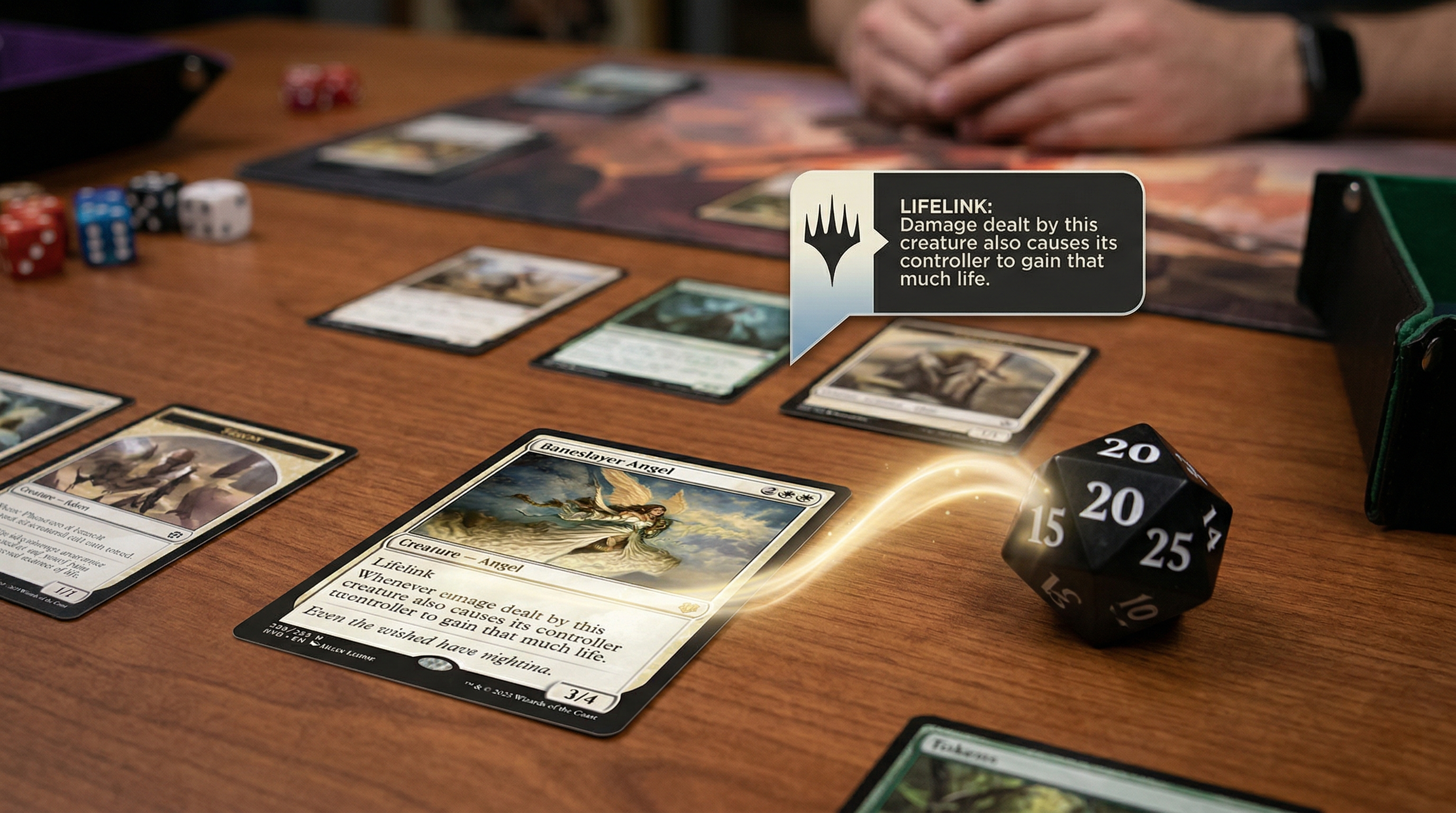
Lifelink is a static ability that causes you to gain life simultaneously with dealing damage—and that single word 'simultaneously' changes everything. Understanding the M10 rules shift, the Spirit Link loophole, and modern 2026 metagame applications separates casual play from competitive dominance.
SEALED PRODUCTS

Duskmourn: House of Horror Play Booster Box
Best for Lifelink - Life drain and survival mechanics built around gaining and losing life
- ✓Survival horror theme revolves around life manipulation
- ✓Orzhov (W/B) archetype loaded with lifelink and life-drain creatures

Bloomburrow Play Booster Box
Best for Lifegain Decks - Bat archetype is a dedicated lifelink engine
- ✓Bat archetype (W/B) is entirely built around lifelink and lifegain
- ✓Zoraline, Cosmos Caller is a premier lifelink commander
SAFETY TECHNOLOGY Expert Analysis.
In the sprawling ecosystem of Magic: The Gathering mechanics, few abilities hold as much strategic depth beneath a deceptively simple surface as lifelink. On the surface, the concept is intuitive: your creature deals damage, you gain life. But beneath that simplicity lies a history of sweeping rules changes, persistent community myths, and a modern 2026 metagame where the line between survival and domination hinges on understanding exactly when and how that life is gained.
From the triggered ability origins of Spirit Link in 1994 to the static keyword revolution of Magic 2010, lifelink has undergone one of the most fascinating mechanical evolutions in the game's history. The consequences of that evolution—simultaneous resolution, redundancy rules, and the critical distinction between old and new card text—define competitive play in 2026.
Whether you're piloting Orzhov Control in Standard, building a lifegain Commander deck around Oloro or K'rrik, or simply trying to understand why your Spirit Link aura stacks with a creature's printed lifelink keyword, this guide provides the definitive mechanical, strategic, and historical breakdown for the modern era.
The Core Mechanics: How Lifelink Works on the Battlefield
To navigate the 2026 metagame with confidence, you must move beyond reminder text and understand the rigid legal framework governing lifelink. The interaction of static abilities with damage resolution and state-based actions is the foundation upon which all strategic insights are built.
The Official Rulebook Definition (CR 702.15)
According to the Magic: The Gathering Comprehensive Rules, lifelink is classified as a static ability that modifies the result of damage being dealt.
CR 702.15a: Lifelink is a static ability.
CR 702.15b: Damage dealt by a source with lifelink causes that source's controller, or its owner if it has no controller, to gain that much life (in addition to any other results that damage causes).
CR 702.15f: Multiple instances of lifelink on the same object are redundant.
The critical word in this definition is static. Unlike triggered abilities that use the stack and can be responded to, lifelink directly modifies the mathematical outcome of a damage event. There is no window for an opponent to intervene between the damage being dealt and the life being gained. They are the same event.
Zone Independence
The rules governing lifelink function regardless of the zone from which an object deals damage. If an object changes zones before an effect causes it to deal damage, the game utilizes its last known information to determine whether it possessed lifelink at the time it left the battlefield. This edge case matters in scenarios involving delayed damage triggers or effects that reference permanents that have already left play.
Simultaneous Resolution: Surviving Lethal Damage and State-Based Actions
The single most important strategic implication of lifelink's static nature is simultaneous resolution. Because the life gain is not a separate event placed on the stack, it modifies the game state before state-based actions are checked for lethal damage.
The Survival Scenario:
Consider the following combat situation: You are at 2 life. Your opponent attacks you with an unblocked 4/4 creature. Simultaneously, your 3/3 creature with lifelink deals combat damage to an opposing blocker.
The Math:
- All combat damage is dealt simultaneously
- You take 4 damage (2 - 4 = -2) and simultaneously gain 3 life from your lifelink creature
- Net life total: 2 - 4 + 3 = 1 life
- State-based actions check: your life total is 1, which is greater than 0
- You survive
If lifelink were a triggered ability (as it was before 2009), the life gain would go on the stack. State-based actions would check your life total at -2 before the trigger resolved, and you would lose the game. This distinction is the single most impactful consequence of the 2009 rules change.
The Pre-2010 Trap
Returning players who learned the game before Magic 2010 often remember lifelink as a triggered ability that used the stack. Under the modern rules, lifelink is instantaneous and cannot be responded to. If you learned to play during Lorwyn or Time Spiral, your muscle memory is wrong—recalibrate accordingly.
Beyond Combat: Fight Spells, Pingers, and Activated Abilities
Lifelink applies to all forms of damage dealt by the source possessing the keyword, not just combat damage. This is a frequently overlooked rule that dramatically expands the mechanic's strategic applications.
Lifelink applies when:
- A creature with lifelink "fights" another creature via a spell like Prey Upon or Bite Down
- A creature with lifelink uses an activated ability to deal direct damage (e.g., a Tim or "pinger" creature equipped with Basilisk Collar)
- A creature with lifelink deals damage through a "bite" effect where only it deals damage to the target
- A spell or permanent with lifelink deals non-combat damage of any kind
Lifelink does NOT apply when:
- Damage is prevented entirely (Protection, Fog effects)
- The damage-dealing effect causes loss of life rather than damage (these are mechanically distinct in MTG)
- The source no longer has lifelink at the time damage is dealt
The Basilisk Collar Play
One of the most potent lifelink strategies in Commander involves equipping creatures with damage-dealing activated abilities (pingers) with Basilisk Collar, which grants both lifelink and deathtouch. A 1/1 creature that taps to deal 1 damage now kills any creature it targets (deathtouch) and gains you 1 life (lifelink) per activation. This combination has been a format-defining interaction in EDH for over a decade.
Common Myths and Complex Rules Clarifications
The mechanics of lifelink sit at a precarious intersection of intuitive casual gameplay and highly technical tournament rules. While the broader player base grasps the core concept, deep strategic play relies on navigating a labyrinth of edge cases, historical rule changes, and persistent community myths.
Does Lifelink Stack? (Understanding Redundancy)
The most pervasive myth among beginner and returning players is that granting a creature multiple instances of the lifelink keyword will multiply the life gained. The official rules explicitly state this is false.
Comprehensive Rule 702.15f dictates that multiple instances of lifelink on the same object are strictly redundant. Giving a creature with innate lifelink an equipment like Shadowspear will not double the healing output. The creature has lifelink. Adding lifelink again does nothing.
This is consistent with how other static keyword abilities work in Magic. Multiple instances of flying, trample, or vigilance on the same creature are equally redundant.
The "Spirit Link" Loophole: Triggered vs. Static Abilities
Yet the "stacking" myth persists for a reason: a strategic loophole exists through pre-2010 card design that creates a functionally similar outcome.
Older auras such as Armadillo Cloak and Spirit Link do not possess the lifelink keyword. Instead, they feature a triggered ability that reads: "Whenever enchanted creature deals damage, you gain that much life." Because this is a triggered ability that utilizes the stack, it operates independently of the static lifelink rules.
The Result: A creature that naturally possesses lifelink and is enchanted by Armadillo Cloak will indeed heal its controller twice—once instantly via the static lifelink ability, and a second time when the aura's triggered ability resolves on the stack.
The Ownership Trap in Commander
The "who gains the life" distinction is critical in multiplayer. If Player A enchants Player B's creature with the aura card specifically named Lifelink, Player B gains the life—because the aura grants the static keyword to the creature, and the creature's controller gains the life. Conversely, if Player A enchants Player B's creature with Spirit Link, Player A gains the life—because the aura's triggered ability is controlled by Player A. This distinction can weaponize an opponent's attacker in your favor.
The Overkill Calculation: Damage Assignment vs. Blocker Toughness
In casual play, it is frequently misconstrued that life gain from lifelink is capped by the defending creature's toughness. This is categorically false.
The Scenario: A 20/20 creature with lifelink is blocked by a 1/1 token.
Common Misconception: "I only gain 1 life because the blocker only has 1 toughness."
Actual Rules (CR 510.1a): Creatures assign combat damage equal to their full power, regardless of the blocker's toughness. The 20/20 lifelink creature deals its full 20 damage to the 1/1 blocker, resulting in 20 life gained by the controller.
This excess damage is dealt irrespective of whether the attacking creature possesses the trample keyword. Trample is only relevant for determining whether excess damage carries over to the defending player—it has no bearing on the amount of life gained via lifelink.
The Limits of Healing: Interactions with Protection and Damage Prevention
Lifelink fundamentally requires damage to actually be dealt. It cannot bypass prevention effects.
Protection from a specific color or card type (CR 702.16a): If a green creature with lifelink attacks and is blocked by a creature with "Protection from Green," the combat damage is reduced to zero. Because zero damage is dealt, zero life is gained.
Fog Effects: Spells like Fog prevent all combat damage. If combat damage is prevented, no lifelink life gain occurs.
Indestructible: Indestructible does NOT prevent damage. A creature with indestructible still takes damage (it just isn't destroyed by it). If a lifelink creature deals damage to an indestructible creature, the full life gain still applies.
The History of Lifelink: A Game Design Evolution
The mechanical evolution of lifelink represents one of the most fascinating case studies in the iterative design philosophy of Magic: The Gathering. To understand the strategic implications of the mechanic in the modern 2026 metagame, one must trace its development from early, convoluted triggered abilities to the streamlined, evergreen static keyword utilized today.
The Future Sight Origins and the Push for Keywording (2007)
The conceptual precursor to lifelink arrived in August 1994 with the release of The Dark. This set introduced the aura enchantment Spirit Link, which bore the text: "Whenever enchanted creature deals damage, you gain that much life." This phrasing established the mechanical identity of life gain tethered to damage output, functioning strictly as a triggered ability that utilized the stack.
For over a decade, this triggered wording proliferated across various sets. As the game expanded, the cognitive load on players increased. Mark Rosewater, Head Designer, championed a design philosophy centered on "keywording"—distilling complex abilities into single words to save critical text box space and open up new design avenues.
This philosophy culminated in May 2007 with the release of the Future Sight expansion. Future Sight officially introduced the keyword "lifelink" to the Magic lexicon, premiering on cards such as Daybreak Coronet and Mistmeadow Skulk. Initially, Wizards of the Coast applied sweeping errata to older cards, retroactively granting the lifelink keyword to any card that possessed the exact triggered phrasing of Spirit Link.
Mark Rosewater has written extensively about the value of keywords in Magic design. The act of keywording an ability accomplishes three things simultaneously: it saves physical text box space on cardboard, it creates a "handle" that designers can reference on future cards, and it establishes an identity that players can learn once and recognize forever. Lifelink was a prime candidate because the triggered wording was long, appeared on many cards, and was intuitively understood by players.
The Magic 2010 Paradigm Shift: Fixing the Stack
The most significant turning point in the history of the mechanic occurred in the summer of 2009. Leading up to the release of the Magic 2010 core set, Wizards of the Coast initiated a massive overhaul of the game's foundational rules, famously eliminating "damage on the stack" and fundamentally altering combat mathematics.
On July 11, 2009, lifelink was officially transitioned from a triggered ability to a static ability. This change was implemented to align the mechanic with human intuition—players instinctively felt that dealing damage and gaining life should be a simultaneous exchange, not a sequential process mediated by the stack.
Because static abilities function differently than triggered abilities, Wizards of the Coast was forced to reverse its previous errata. Cards printed with the old triggered wording were reverted to their original text and stripped of the lifelink keyword, forever bifurcating the mechanics into two distinct categories:
- Modern lifelink (static, simultaneous, redundant)
- Classic triggered life gain (uses the stack, sequential, stacks with itself)
The notable exception to this reversion was Loxodon Warhammer, which retained the lifelink keyword despite its original triggered wording—a deliberate design choice by Wizards that recognized the card's iconic status.
The Modern Era: Universes Beyond and the 2026 Metagame
The mechanic remained structurally stable for the next fifteen years, cementing itself as a core, evergreen mechanic alongside flying and trample. The next major paradigm shift involved not the rules of lifelink, but the format legality of the cards that possessed it.
In August 2025, Wizards of the Coast announced a fundamental shift to the Standard rotation model. Universes Beyond sets—franchise crossovers previously relegated to Commander, Legacy, and Vintage—became fully legal in Standard, Pioneer, and Modern. Furthermore, the traditional autumn rotation was abolished.
As of early 2026, the Standard environment encompasses an unprecedented 14+ sets, including:
- Wilds of Eldraine through Duskmourn (Late 2023 - 2024)
- Foundations and Lorwyn Eclipsed (Late 2024 - Early 2026)
- Magic: The Gathering — FINAL FANTASY (2025)
- Magic: The Gathering | Marvel's Spider-Man (2025)
- Magic: The Gathering | Teenage Mutant Ninja Turtles (March 2026)
No Standard Rotation in 2026
Wizards of the Coast has officially decreed that there will be no Standard rotation during the 2026 calendar year. The next rotation is scheduled to occur with the first set release of 2027. Standard now encompasses three years' worth of sets. This means decks built today have an extended competitive shelf life, and lifelink interactions cross-pollinate between traditional Magic sets and Universes Beyond properties.
Tactical Application: Treating Life as an Active Currency
Most beginner-focused articles frame lifelink solely as a defensive survival tool against aggressive decks. While this is absolutely one of its applications, limiting your understanding to "gain life, don't die" misses the deeper strategic picture. In competitive Magic, life is a resource to be spent—and lifelink is the engine that refuels the tank.
Surviving Aggro: The Control Deck's Ultimate Stabilization Tool
In the most fundamental application, lifelink serves as a stabilization mechanism for midrange and control strategies against hyper-aggressive red decks. A single lifelink blocker can swing a damage race by 6 or more points in a single combat step (the damage it prevents by blocking plus the life it gains).
In the 2026 Standard metagame, the Orzhov (White/Black) Control and Midrange archetypes rely heavily on lifelink-adjacent cards like Case of the Uneaten Feast, Zoraline, Cosmos Caller, and Amalia Benavides Aguirre to stabilize against aggressive openings before deploying finishers.
Weaponizing Lifegain: Drain Effects, Sanguine Bond, and Payoffs
The paradigm shift occurs when you stop viewing life gain as defense and start viewing it as fuel. Modern Magic design has created an entire ecosystem of cards that convert life gain events into tangible board advantages:
- Ajani's Pridemate (and variants): Gains a +1/+1 counter whenever you gain life. Multiple lifelink creatures dealing damage simultaneously trigger it multiple times (CR 702.15e).
- Sanguine Bond / Vito, Thorn of the Dusk Rose: Whenever you gain life, target opponent loses that much life. This converts every lifelink hit into a direct drain effect.
- Heliod, Sun-Crowned: Converts life gain events directly into +1/+1 counters, serving as the centerpiece of a devastating combo with Walking Ballista.
- Dina, Soul Steeper: Converts lifegain into direct opponent life drain in the command zone, providing a persistent engine in Golgari sacrifice strategies.
The advanced player understands that 20 life (or 40 in Commander) is not a score to protect—it is a budget to spend. Cards like Bolas's Citadel, Necropotence, and the Phyrexian mana mechanic demand life payments in exchange for massive tempo advantages. Lifelink is the credit line that keeps these payments sustainable. The goal is not to stay at 20 life; the goal is to spend life faster than your opponent while using lifelink to keep the account from hitting zero.
Paying for Power: Phyrexian Mana and Black Market Connections
The most extreme expression of "life as currency" is found in Mono-Black Commander strategies led by K'rrik, Son of Yawgmoth. K'rrik's signature ability allows you to pay 2 life instead of for any black mana symbol in a casting cost. This effectively lets you cheat enormous spells into play turns ahead of schedule—provided you have the life to pay.
Lifelink is the mechanism that keeps K'rrik decks from self-destructing. A single lifelink creature swinging for 5 damage replenishes 10 mana worth of Phyrexian payments. Cards like Whip of Erebos and Basilisk Collar are not defensive tools in these decks; they are accelerants that enable the engine to sustain its explosive output.
Top Lifelink Cards and Commanders in the 2026 Metagame
EDH All-Stars: Oloro, Heliod, Lathiel, and K'rrik
The following table categorizes the highest-performing lifegain commanders in the 2026 EDH metagame by their strategic payoff and estimated investment cost.
Price Disclaimer
The deck price tiers listed above are estimates based on historical secondary market trends and general archetype costs. Actual prices vary based on specific card choices, condition, and market conditions. Always verify current prices on TCGPlayer or your preferred marketplace before purchasing. This is not financial advice.
Standard 2026 Powerhouses (Orzhov Control and Universes Beyond)
The unprecedented 14-set Standard environment of 2026 has created a rich ecosystem for lifelink strategies. The Orzhov (White/Black) shell remains the dominant lifegain archetype, leveraging incidental lifelink to fuel powerful payoff engines.
Key Standard Lifelink Interactions:
- Amalia Benavides Aguirre + any lifelink creature creates an explore chain that can rapidly grow Amalia to lethal size or clear the board
- Case of the Uneaten Feast provides consistent lifegain triggers that synergize with the broader Orzhov control package
- Anti-Venom, Horrifying Healer from the Marvel's Spider-Man set introduces unique damage-prevention and counter-generation mechanics that interact with lifelink in novel ways
The FINAL FANTASY set contributed 19 specific cards with the lifelink keyword, significantly expanding the pool of aggressive lifelink threats available to Standard deckbuilders. The Teenage Mutant Ninja Turtles set (March 2026) showcases high intersections between token generation and lifelink equipment strategies.
The Best Lifelink Enablers (Equipment, Auras, and Lands)
Not every creature is born with lifelink. The following enablers grant the keyword to creatures that lack it, and each has been a format-defining card at various points in Magic's history:
- Shadowspear (1 mana, Equipment): Grants +1/+0 and lifelink/trample. Also removes hexproof and indestructible from opposing permanents. A staple in virtually every Commander deck that runs creatures.
- Basilisk Collar (1 mana, Equipment): Grants deathtouch and lifelink. The combination with pinger creatures is devastating.
- Whip of Erebos (4 mana, Enchantment Artifact): Grants all your creatures lifelink. Also reanimates creatures from the graveyard with haste.
- Loxodon Warhammer (3 mana, Equipment): Grants +3/+0, trample, and lifelink. The original lifelink equipment and a historical powerhouse.
- Soulfire Grand Master (2 mana, Creature): Grants lifelink to instant and sorcery spells you cast. Lightning Bolt becomes Lightning Helix.
The Financial Landscape: Collecting and Investing in Lifelink
While the competitive applications of lifelink are well documented, the financial dimension of collecting lifelink-relevant cards in the 2026 market deserves careful analysis—particularly given the unprecedented integration of Universes Beyond properties into premier competitive formats.
Navigating the 2026 TCG Market: Selling into Hype
The Trading Card Game secondary market is notoriously volatile. Prices are driven by unpredictable metagame shifts, unannounced set reprints, content creator influence, and speculative buyouts. The recommended strategy for TCG investors navigating the 2026 market centers on three principles:
- Sell into hype: When a new set releases and creates demand for specific lifelink synergy cards, capitalize on the initial price spike before the market corrects
- Liquidate failed speculations quickly: If a card doesn't perform in tournament results within the first two weeks, the price trajectory is almost always downward
- Manage FOMO: The fear of missing out on high-dollar Universes Beyond products drives irrational purchasing behavior. Maintain discipline
The Universes Beyond Premium: TMNT and Final Fantasy Collector Boosters
The Collector Booster variants of Universes Beyond sets command significant premiums due to exclusive treatments, serialized inserts, and cross-franchise collector appeal. Foil lifelink uncommons from these sets can carry surprising value when they intersect with both casual Commander demand and competitive Standard/Pioneer playability.
Current 2026 Standard Legality Quick Reference
The following table provides clarity regarding the shifting rotation schedule and the integration of Universes Beyond sets—information that directly impacts which lifelink cards are available for competitive Standard play.
Standard Rotation Caveat
There is no Standard rotation occurring in the calendar year 2026. The next scheduled rotation occurs with the first set release of 2027. Because Standard now utilizes a three-year cycle, decks built today have an extended competitive shelf life. Furthermore, while the main sets of Marvel's Spider-Man and TMNT are Standard-legal, certain Commander-specific cards printed in their associated preconstructed decks are not legal in Standard, Pioneer, or Modern. Always verify individual card legality.
Quick Reference Rules FAQ
The following questions address the highest-volume search queries surrounding the lifelink mechanic, grounded in official Comprehensive Rules and verified through primary sources.
Does lifelink stack? No—multiple instances of the lifelink keyword are redundant (CR 702.15f). However, older cards with triggered "gain life" text like Spirit Link stack with modern lifelink because they are mechanically distinct abilities.
Does lifelink only work in combat? No. Lifelink applies to all damage dealt by the source: combat damage, fight damage, bite damage, activated ability damage, and any other form of damage.
Can lifelink save me from lethal damage? Yes. Life gain from lifelink is simultaneous with damage, so state-based actions check your life total after both are applied.
Does overkill damage count for lifelink? Yes. A creature deals damage equal to its full power regardless of the blocker's toughness. All of that damage generates lifelink healing.
Does lifelink work against Planeswalkers and Battles? Yes. Any successful damage dealt to any target generates lifelink healing for the source's controller.
Who gains the life—the creature's controller or the aura's controller? For the modern lifelink keyword: the creature's controller. For the old triggered Spirit Link text: the aura's controller.
How does lifelink interact with Double Strike? The creature deals damage twice (first strike step and regular damage step), so you gain life twice. This effectively doubles the lifelink output.
Do multiple lifelink creatures create separate life gain events? Yes (CR 702.15e). Three lifelink creatures dealing damage simultaneously create three separate life gain events, triggering cards like Ajani's Pridemate three times.
Conclusion: The Unrelenting Strategic Value of Refusing to Die
Lifelink is not a defensive mechanic. It is a resource engine disguised as a survival tool. The player who understands this distinction—who treats their life total as a budget to spend rather than a score to protect—will consistently outperform opponents who view lifelink as nothing more than a safety net.
The 2026 metagame demands a holistic understanding of lifelink that spans three decades of design history. From the triggered ability origins of Spirit Link in 1994, through the paradigm-shifting M10 rules update of 2009, to the Universes Beyond convergence that has flooded Standard with cross-franchise lifelink interactions in 2026, the mechanic has evolved from a simple combat trick into a cornerstone of competitive strategy.
The Rules Lesson:
- Lifelink is a static ability (CR 702.15)—it does not use the stack
- Life gain is simultaneous with damage and can save you from lethal
- Multiple instances of the keyword are redundant, but old triggered text stacks with modern lifelink
- Lifelink applies to all forms of damage, not just combat damage
The Strategic Lesson:
- In aggro matchups, lifelink is your stabilization tool
- In midrange and control, lifelink is fuel for powerful payoff engines
- In Commander, lifelink scales with life-spending commanders like K'rrik and Bolas's Citadel
- Life is a currency—lifelink is the income stream
Whether you're navigating a complex Standard metagame, building your first Commander lifegain deck, or simply resolving a combat step correctly at your kitchen table, mastering lifelink is one of the highest-return investments you can make in your Magic: The Gathering education.
External References
- Magic: The Gathering Comprehensive Rules — Rule 702.15 (Lifelink)
- Rules Changes 2009 — M10 Rules Update (Wizards of the Coast)
- Aligning the Universes — Universes Beyond Standard Legality (Wizards of the Coast)
- Marvel's Spider-Man Release Notes (Wizards of the Coast)
- Making Magic: The Space Between The Notes — Mark Rosewater on Keywording
- Draftsim: The 37 Best Lifegain Commanders in Magic Ranked
- MTGGoldfish: Standard Lifegain Decks
- CoolStuffInc: The 25 Best MTG Lifelink Cards
- Scryfall — Search for Lifelink Cards
Frequently Asked Questions
🔗 Related Resources
More Reviews:
Related Articles
.jpg)
Hexproof vs Shroud MTG: The Complete Difference Explained (2026)
Hexproof vs Shroud in Magic: The Gathering — what the two abilities actually do, why they're not the same, and which one is stronger in 2026 Commander, Modern, and Standard play.
.png)
MTG Legend Rule Explained: How Legendary Permanents Work (2026)
The MTG legend rule explained in full — what triggers it, how the modern '2013 fix' works, and how legendary creatures, lands, and artifacts interact with each other in 2026 Commander, Modern, and Standard play.
.png)
MTG Persist vs Undying: The Complete Mechanic Comparison (2026)
Persist vs Undying in Magic: The Gathering — the rules, counter interactions, combo applications, and which one is stronger in 2026 Modern, Commander, and Pioneer.